Brain connectome mapped at the mesoscale


The brain is comprised of “cities” and “buildings” with different functions. Like “information roads”, numerous neural connections link them into a network. Based on the brain network, information is input from sensory organs and transmitted and processed in the brain. It ultimately produces memories, emotions, and behaviors. Therefore, understanding the brain calls for the command of the “traffic map", just as people should have a GPS when they travel. However, at present, there is no complete “traffic map” for reference when scientists explore the mysteries of the brain.
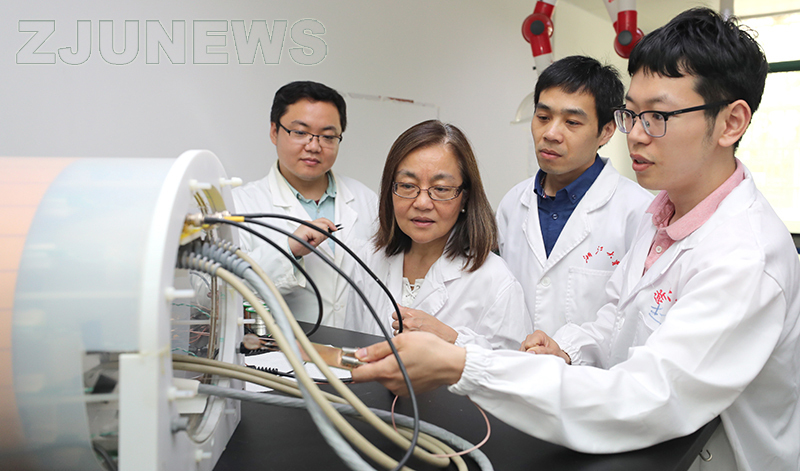
The research team led by Prof. Anna Wang Roe from the ZJU Interdisciplinary Institute of Neuroscience and Technology published an article regarding a major breakthrough in research into brain-wide networks in the April 24 issue of the journal of Science Advances. They employed focal pulsed infrared neural stimulation in functional magnetic resonance imaging (fMRI) to develop an alternative approachto mapping brain connections that combines pulsed near-infrared neural stimulation (INS) with ultra high-field fMRI (INS-fMRI). They pioneered in stimulating single submillimeter domains and their associated networks. These INS-induced hemodynamics signals could be used in ultra high-field MRI to map mesoscale resolution networks at both global and local scales.
Mapping connection patterns in the brain is essential for understanding brain networks and its relationship to behavior and disease. There are many approaches to mapping connections in the brain. However, there is no method to systematically map connections in vivo rapidly with millimeter-scale resolution at a brain-wide scale at present. Anatomical mapping methods based on tracer injections 1 to 5 mm in size are limited to a small number of injection sites (typically three to five tracers) and require 2 to 3 weeks for tracer transport, animal sacrifice, and time-consuming reconstruction.
Against this backdrop, Prof. Anna Wang Roe devised a novel approach by using focal INS stimulation in the MRI for in vivo mapping of brain networks. The specificity and focal nature of activated target sites suggest a true reflection of anatomical connectivity. Furthermore, these signals can be mapped under quite different conditions (two different sensory cortical areas, two different species, and two different ultrahigh-field MRI systems), indicating generality of methodology.
Compared with anatomical mapping, INS-fMRI offers certain advantages. Connections can be studied in vivo, thereby reducing the number of animals needed. fMRI maps are rendered in three dimensions directly on anatomical brain scans (eliminating time-consuming reconstruction). What’s more, it is rapid as it can be acquired within a single 1- to 2-hour fMRI session. These merits permit the study of multiple networks within a single animal, further opening up new avenues for correlating multiple types of datasets (e.g., electrophysiology and behavioral data) from an individual animal. These results demonstrate that the use of ultrahigh-field fMRI provides sufficient signal-to-noise ratio for high spatial resolution mapping, facilitating the study of brain-wide networks at a mesoscale.
This method can be widely applied to multiple areas of the brain in different species and across different MRI platforms. It will lay a solid foundation for mapping high-resolution brain networks and open the door for research into brain connectomes. Sorting out the connectivity of different functional columns will be of immense help for the understanding of the working principle of the brain and brain disease in primates, thus promoting the development of neuroscience, psychology, medicine and artificial intelligence.