AI facilitates the prediction of CO2 adsorption


With the acceleration of the global modernization process, CO2 emissions have escalated tremendously and the greenhouse effect has intensified, contributing to global warming and rising sea levels. The human living environment and the ecological balance have thus been deleteriously affected. It has become the focus of scholars to engage in researching into technologies concerning CO2 separation, capture, storage and utilization in a cost-effective way. Porous materials for CO2 adsorption have great potential due to their exceptionally remarkable kinetics. However, the factors affecting the adsorption of porous carbon CO2 remain obscure. The conventional adsorption model can do nothing more than establish a linear connection between the structural parameters of a single porous carbon with the CO2 adsorption capacity. Moreover, due to a poor computational capacity, very few data samples can be available (generally no more than 20 sets of data), resulting in low precision and limited applications.
The research team led by FU Jie, an associate professor in the College of Chemical and Biological Engineering, Zhejiang University, constructed an artificial intelligence system based on deep learning.
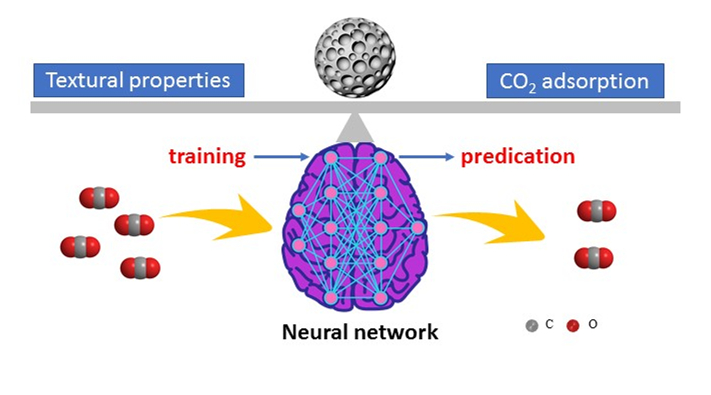
In this study, the conspicuous consistency between experimental and predicted value about CO2 adsorption capacity is achieved only when Vmicro‐Vmeso‐SBET are chosen as the input neurons simultaneously. More importantly, the trained deep neural network (DNN) can make an accurate prediction about CO2 adsorption capacity for more than 1000 data samples. This study is of immense significance in the following dimensions. First, the big data investigation further validates the importance of Vmeso in controlling gas uptake, refuting a long‐held notion that Vmicro is an only parameter in controlling gas absorption of small molecules. Second, SBET is an independent textural parameter that can be synergistically coupled with other textural parameters in determining gas–solid interactions and thus gas‐uptake capacities. Third, the gas‐uptake by solid adsorbents relies on the complex interplay among the textural parameters with the sensitivity of each parameter that can be estimated.
Therefore, this unprecedented deep learning neural network approach exhibits great potential to predict gas adsorption and guide the development of next‐generation carbons.
The findings of this study are published in an article entitled “Prediction of Carbon Dioxide Adsorption via Deep Learning” in the journal of Angewandte Chemie International Edition.