Mo-based catalysts able to restore performance


The research team led by Prof. WANG Yong at ZJU's Department of Chemistry published an article entitled “Redispersion of Mo-Based Catalysts and the Rational Design of Super Small-Sized Metallic Mo Species” in the journal of ACS Catalysis.
They report particle redispersion at Mo catalysts, in which small-sized Mo species can be achieved from the original large-sized Mo oxide on a carbon support (carbon cloth) in the H2 atmosphere. The small-sized Mo species expose a largenumber of active sites, which exhibit a high Faradaic efficiency (FE) in the electrocatalytic nitrogen reduction reaction (NRR).
Metal nanoparticle catalysts are widely employed in heterogeneous catalysis. In most cases, metal nanoparticles expose an abundance of low-coordination sites, which could act as active sites and boost catalytic activity. However, agglomeration of nanoparticles, which occurs frequently, leads to catalytic deactivation, particularly in harsh conditions. Redispersion thus needs to be conducted for restoring the performance in actual applications, thereby increasing costs. Recently, there has been massive research into Pt nanoparticles which can realize redispersion on ceria support by calcining samples at high temperatures in the oxidative atmosphere. Follow-up studies reveal that this may restrict its application to some extent.
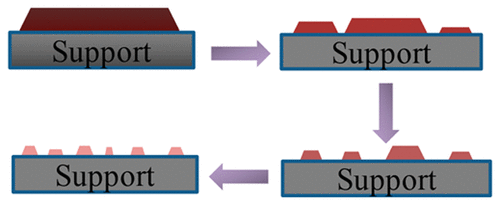
Prof. WANG Yong and his team engage in research into redispersion in the H2 atmosphere. They present the process of forming small-sized Mo species. The initial MoO2 particles are reduced by H2, and then the big Mo particles would be spilt into small pieces and be trapped by vacancies. The achieved super-small nanoparticles exhibit a remarkable NRR performance.
These findings may inspire a more in-depth understanding of the redispersion phenomenon, which shows immense potential for extensive applications and provides guidance for the rational design of efficient industrial catalysts.