Electricity generated from ocean wave with the frequency of 0.5 Hz


The research team led by Prof. ZHANG Dahai at the Zhejiang University Institute of Ocean Engineering and Technology published a research article in the journal of Nano Energy recently. This article is concerned about a multi-grating triboelectricnanogenerator aimed at harvesting low-frequency ocean wave energy.
Wave energy is one of the most abundant and widely distributed renewable energy resources in the ocean. Current wave energy converters (WECs) are based on electromagnetic generators, which are gigantic in size, prohibitive in cost and low in reliability. In contrast, the triboelectricnanogenerator is marked by its low cost and small size, thereby opening up a potential avenue for harnessing wave energy in a cost-effective manner.
ZHANG Dahai et al. map out a novel WEC design based on the multi-grating triboelectric nanogenerator (MG-TENG) model. It is shown that the designed MG-TENG is capable of delivering over 140 V open-circuit voltage and 60 μA rectified short-circuit currentrespectively, potent enough to power over 60 commercial LEDs. What’s more, its average charging current achieves 12.3 μA, better than most reported TENG models. Particularly, instead of sparse pulse signals generated from those TENG models in the vertical contact-separation mode, the MG-TENG works in a freestanding triboelectric-layer mode able to provide more continuous and smooth power outputs, thus more suitable for the low-frequency wave energy harvesting.
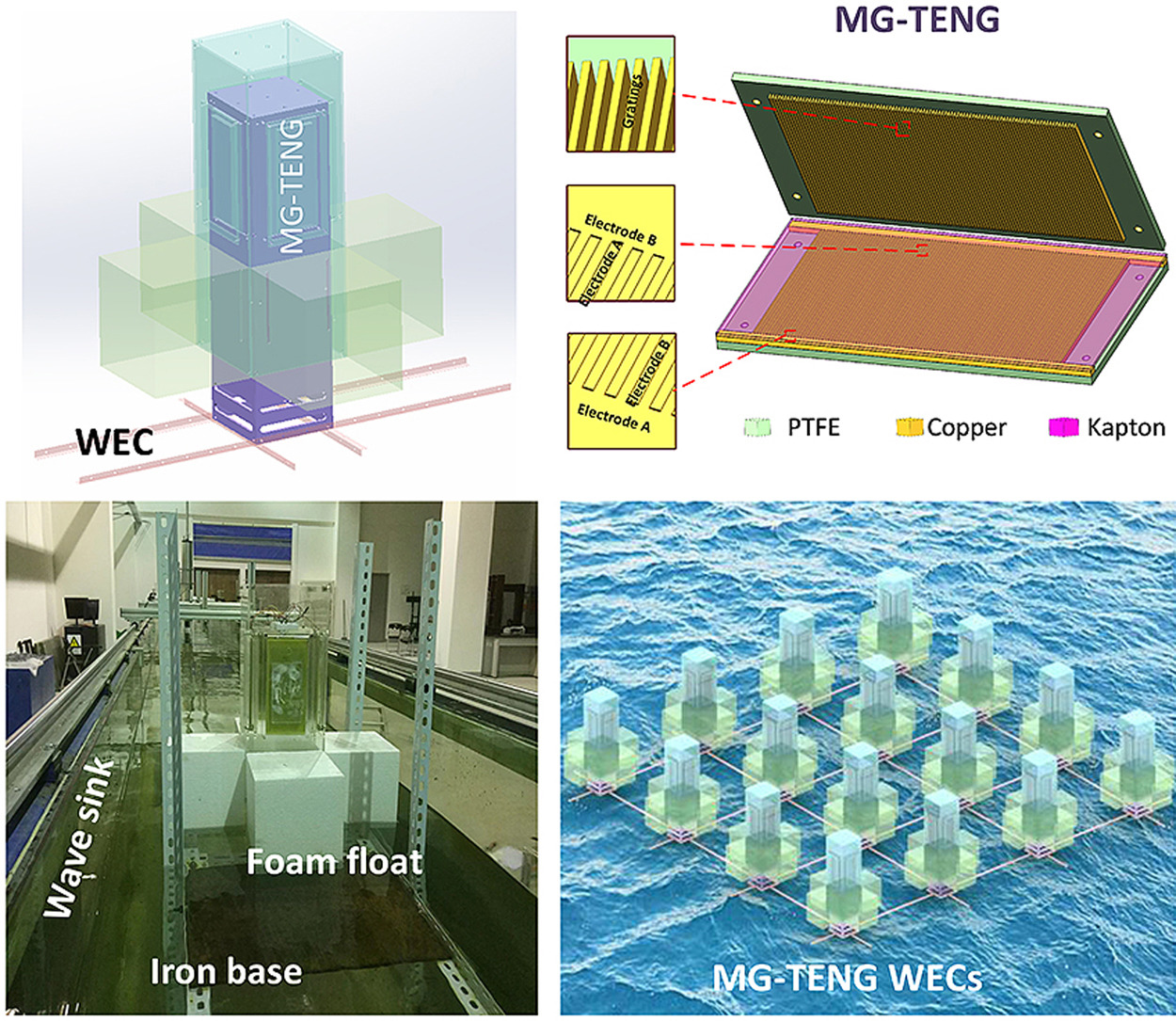
This MG-TENG based wave energy converter is designed, fabricated and tested in a wave tank under different wave conditions. It is observed that the instantaneous power output reaches 54 μW and the instantaneous maximum power output density arrives at 4.2 mW/m2 under the 8 cm and 0.5 Hz wave condition, exhibiting strong power output capability.
The array installation of MG-TENG WECs shows great promise for the power supply system in ocean observation technology, ocean engineering platforms, marine pasture or deep-sea sensors.