A self-adaptive all-in-one delivery chip for skin wound healing


A multi-disciplinary team of ZJU designed a novel self-adaptive all-in-one delivery chip (G:P:Al-Chip) to assemble hybrid polymeric materials and multiple therapeutics within a single microchannel chip to achieve programmed skin nerve restoration based on endogenous stem cell recruitment. Successful in vitro and in vivo applications of this chip demonstrate the promise of utilizing feedback-controlled release systems to facilitate adaptive delivery of therapeutics. This project is led by Associate Professor PENG Lihua and Professor GAO Jianqing from the College of Pharmaceutical Sciences who collaborate with Professor GAO Chao from the Department of Polymer Science and Engineering and Professor HE Yong from the School of Mechanical Engineering. Their research findings are published in the journal of Advanced Functional Materials.
During the skin wound healing, nerve regeneration is critical for the restoration of excitation functions of injuried nerves, a complex process requiring collaborative efforts of many signals. Biochemical and biophysical cues, such as chemoattractant, growth factors, and bioelectricity, are critical to achieve cell recruitment and neuronal regeneration, which are two major steps of in situ regeneration. Inspired by the adaptation and response of cells through communication with their environment, this multidisciplinary team proposed a therapeutic platform based on bottom-up regeneration biology in promoting skin neuroengineering and more complete wound healing.
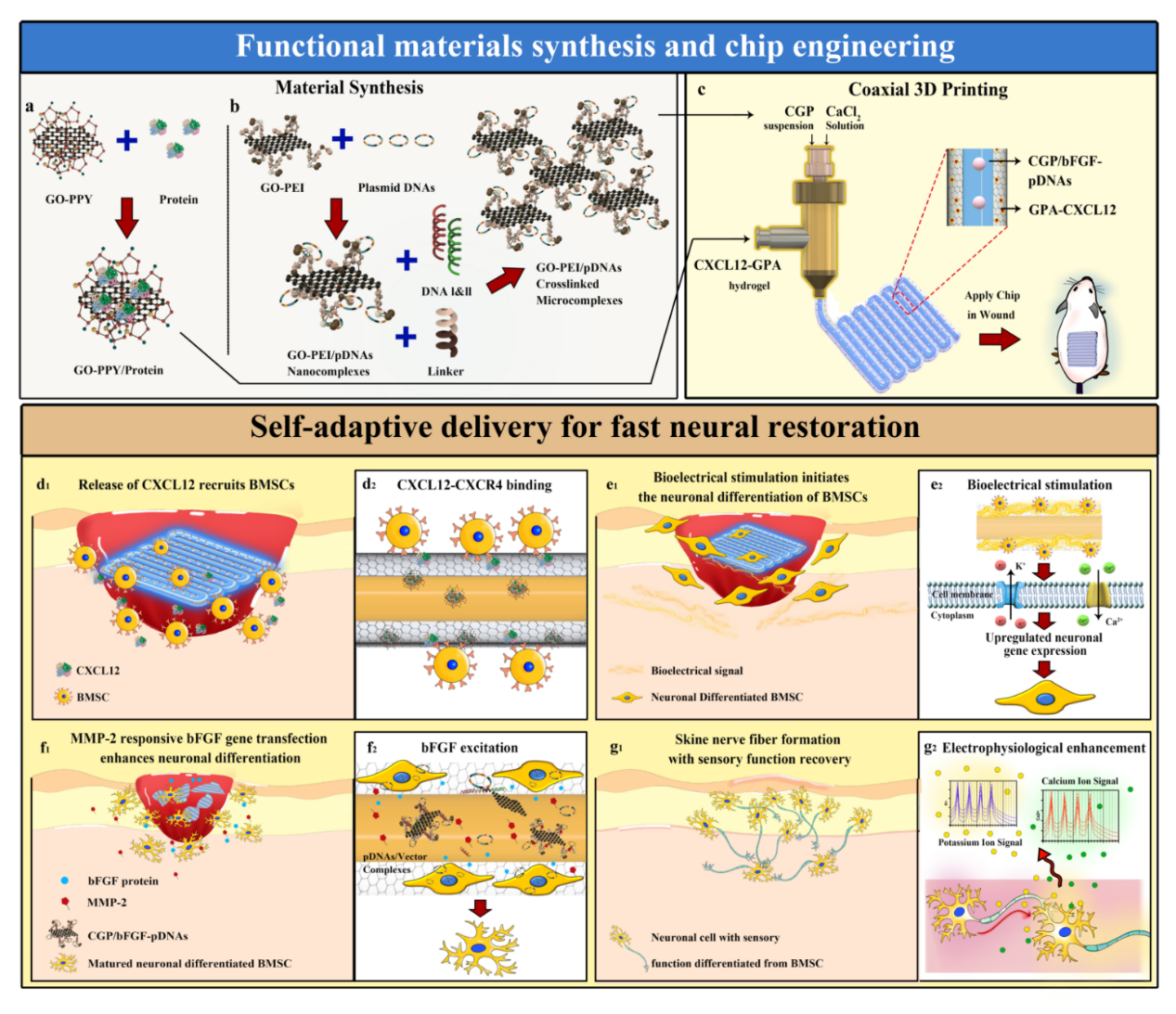
Schematic illustration for the design and hierarchical architecture of G:P:Al-Chip
This smart chip is characterized by degradability, biocompatibility and conductivity, thereby controlling the release of proteins and the assembly of endogenous stem cells and promoting the secretion of specific enzymes to diffuse into the microfluidic channel and degrade the crosslinked GO-PEI (CGP) into GO-PEI/pDNAs nanocomplexes. These nanocomplexes transfect MSCs, stimulating the secretion of bFGF proteins which can trigger nerve fiber formation and neuronal maturation. The regenerated nerve fibers recover the excitation function indicated by vigorous electrophysiological K+ outward flux and calcium ions influx activity.
This all-in-one delivery chip can enhance nerve regeneration with excitation functions within 23 days. This work provides a proof-to-concept to organize recruitment and neuronal regeneration cues for endogenous mesenchymal stem cells by a degradable chip for in situ neuronal regeneration with enhanced functions was verified. Considering most tissues, organs and functional appendages share the similar regenerative mechanisms, G:P:Al-Chip not only offers a useful strategy to stimulate skin neuroengineering, but also gives a universal platform for the regeneration of tissues and organs with complicated structures.