Zero to one: at the cutting-edge of research


“I attach immense importance to the breakthrough from 0 to 1 and strive relentlessly to pursue innovation and transcendence, which is a driving force for my constant efforts in the cutting-edge research,” said ZHU Yongqun, a recipient of the 16th China Youth Science and Technology Award.
ZHU Yongqun has long been committed to research into dangerous disease-inducing bacteria. He has achieved success in unveiling a multitude of “secret weapons” of pathogenic bacteria to overcome immune defenses and resolving a series of long-standing problems regarding the mechanisms of bacterial pathogenesis. ZHU’s lab is currently an international leader in the field of pathogen-host interactions.
ZHU’s research has delved into the molecular level of pathogenic bacteria. His research is intimately bound up with the life and well-being of every individual.
If your hand is accidentally punctured while you are preparing seafood, vibrio vulnificus may take advantage of this situation and cause septicemia. Unfortunately, 75% of the infected people die within 48 hours. Hidden in air conditioners is Legionella pneumophila, which can invade the body in the summer when people are enjoying coolness and lead to serious pneumonia. In recent years, ZHU’s research team has successfully uncovered these “tricks” of treacherous bacteria.
“We have discovered a virulence factor in vibrio vulnificus and vibrio cholera which can immobilize our immune cells and eventually render them useless,” said ZHU Yongqun. This effector factor has become a target for developing new antibacterial drugs. The findings, published in the journal Science, have captured enormous attention.
ZHU Yongqun has also spotted a previously unknown toxin in Legionella pneumophila. Like a pair of scissors, the toxin can cut off the markers that the immune system puts on bacteria and evade immune defense.
“With a clearer understanding of the pathogenic mechanisms of bacteria, we can work out ways to overcome bacterial drug resistance and develop new therapies that will save more lives,” ZHU Yongqun said. These innovative discoveries have been made thanks to his interdisciplinary background. He pursued his undergraduate studies in applied physics and transferred to biology research during his graduate studies. Two of his teachers—Prof. WANG Dacheng, an eminent molecular biophysicist and Prof. SHAO Feng, a distinguished biochemist—opened the door for him to explore the world of life sciences.
“My strength lies in my ability to apply multi-disciplinary approaches in an integrated manner. This empowers me to find more clues and make new discoveries,” ZHU Yongqun said.
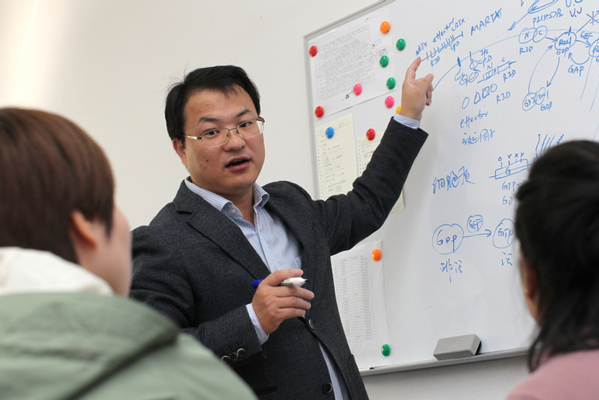
ZHU Yongqun has never wavered in his determination to explore the unknown. In his eyes, one would never succeed in scientific research without dedication and persistence. He arrives at the lab at 9 a.m. and leaves at 11 p.m. day in and day out. He works seven days a week, with only a few days off for the Spring Festival. “As long as we’re heading for the right direction, hard work will translate into success,” ZHU Yongqun said. He obtained the grant for a key project of the National Natural Science Foundation of China (NSFC) at the age of 35, and was the youngest person heading a key NSFC project at Zhejiang University at that time.
To achieve more “0 to 1” breakthroughs is not only ZHU’s requirement for his forthcoming research and innovation work but also his expectation of building Zhejiang province into a science and innovation hub in “life and health”.
“The exploration of the mysteries of nature is full of challenges, and those who have chosen this path should deserve more respect,” ZHU Yongqun remarked. “I believe that Zhejiang province is well-equipped to create a tolerant culture where scientists are willing to take risks. This will become a magnet for talents.”
“Building a science and innovation hub in ‘life and health’ calls for concerted efforts in various agents. Universities, hospitals, and biomedical companies should work closely to create a dynamic ecosystem of innovation,” said ZHU Yongqun.