Decoding personal biotic and abiotic airborne exposome


Human diseases are caused by the interplay between intrinsic molecular dynamics and environmental exposures, which can be broadly defined as biological, chemical, physical and even psychological exposures. Abnormal environmental exposures, especially during early life, can lead to a variety of acute and chronic diseases, including cancer, allergy/asthma and autoimmune diseases.
The ‘exposome’ was first proposed by Christopher Wild to encompass the totality of human environmental exposures from conception onwards. This concept was developed to draw attention to the need for better and more complete understanding of the environmental exposures, in parallel to our extensive knowledge in human genetics. However, methods for directly measuring the dynamics and diversity of biotic and abiotic airborne environmental exposures, especially at the individual level, are lacking. Therefore, it is of vital importance to develop a highly sensitive, precise, and quantitative protocol to decode biotic and abiotic environmental exposures.
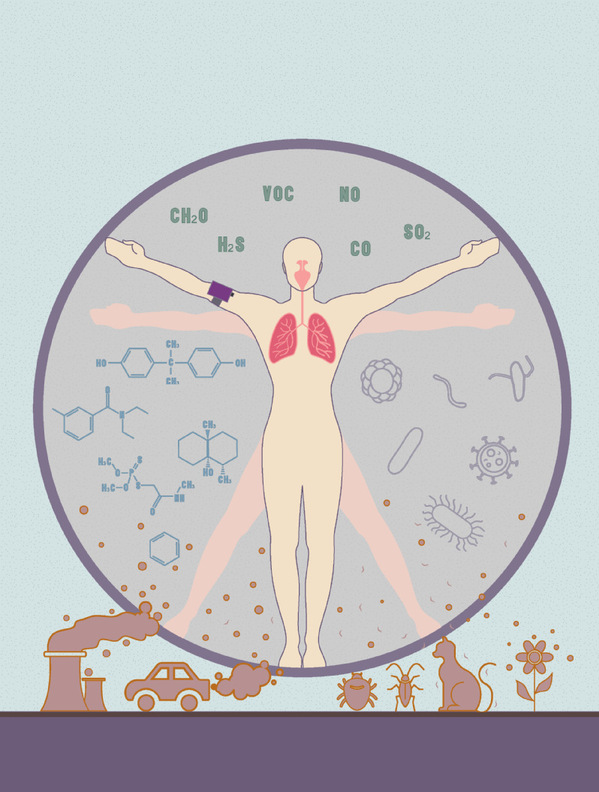
Early exposome studies measured environmental exposures via questionnaires as the self-reported method; environmental monitoring of known toxins and pathogens by targeted methods; monitoring unknown biotic and abiotic stressors by untargeted methods; and Geographic Information System modeling of environmental pollutants using stationary monitoring or wearable technology to quantify personalized physiological reactions to the external exposome. Information of millions of organic chemicals—including pharmaceuticals and personal care products, plasticizers, pesticides, preservatives, flame retardants and microbial metabolites—has already been collected in various databases. However, most of the natural organic chemicals remain unannotated.
In the field of medical science, studies of the exposome in the context of human health usually measure the epigenetic changes inside the human body as proxy data of environmental exposures. In the fields of environmental science and ecology, traditional methods for profiling outdoor and indoor environmental exposures use high-volume air sampling equipment or occasionally smaller portable devices, but the research focus is either on the microbial or chemical components of the exposome, never measuring both concurrently. In addition, in previous studies, marker gene-based detection methods, such as 16S and 18S ribosomal RNA (rRNA) gene-specific amplification and sequencing, though contributing tremendously to the understanding of the identity of airborne microorganisms in various environments, have limited abilities to collect pan-domain airborne environmental exposures and to gain knowledge from the vast and dynamic environmental genetic pool. Similarly, the targeted chemical analysis of environmental samples fails to fully reflect the universe of thousands of chemicals or detect emerging contaminants in the exposome.
Recently, the joint research team led by Dr. JIANG Chao from the Zhejiang University Life Sciences Institute and Dr. Michael Snyder from the Stanford University Department of Genetics published an open-access research article entitled “Decoding personal biotic and abiotic airborne exposome” in the journal Nature Protocols. The article describes a protocol that integrates hardware, experimental pipelines, and computational analyses to collect and decode biotic and abiotic external exposome at the individual level.
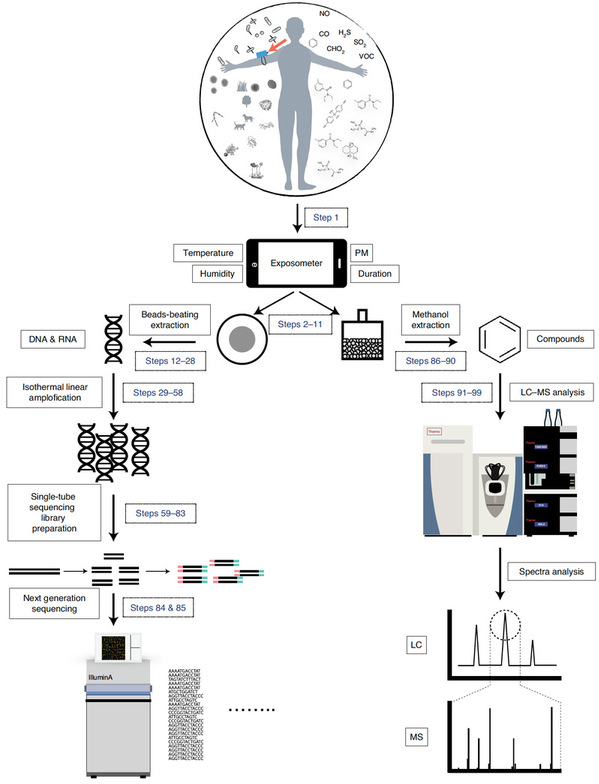
To address various challenges in decoding personal airborne environmental exposures, researchers developed a highly sensitive protocol that integrates a wearable device called an exposometer, which is fitted with custom-designed parts, and optimized experimental processes to collect and decode biotic and abiotic environmental exposures. This sampling method can increase the sensitivity to the sub-nanogram level by incorporating dedicated decontamination steps and isothermal linear amplifications for DNA and RNA. The exposometer also includes a few sensors to measure temperature, humidity, particulate matter (PM) concentration and duration. “This method has been implemented to track the personal environmental exposome from 15 individuals for up to 2 years,” said Dr. JIANG. “We have also identified over 2,500 species and annotated nearly 1,000 compounds, revealing the highly complex and dynamic spatiotemporal personal exposome for the first time.” Dr. JIANG commented that he anticipates that the methods described in this study, with or without modifications, will be integrated into the emerging exposome field to study the impact of exposome at the global, metropolitan, and individual levels.
More information:Dr. JIANG Chao and Dr. Mike Snyder were corresponding authors. Dr. JIANG Chao, Dr. Xinyue Zhang and Dr. Peng Gao were first authors. Dr. CHEN Qiong was the contributing author.