DIY relic restoration: a facelift for cultural heritage


Turn the spotlight on this scene: in a common classroom in ZJU’s Xxi campus, students in lab-gown were operating the optical fibers, trying to build a spectral measuring system by connecting them to fiber optic spectrometer. Alongside them were the classmates observing the sample by polarization microscope.
Exclusive to students of science? Not exactly! This scene was familiar to Cultural Heritage Conservation Lab, an undergraduate course in ZJU’s School of Arts and Archaeology. In this class, majors in Cultural Heritage and Museology revived vivid traditional Chinese frescoes from the scratch, conducting a facelift for cultural heritage with conservation science and technology.
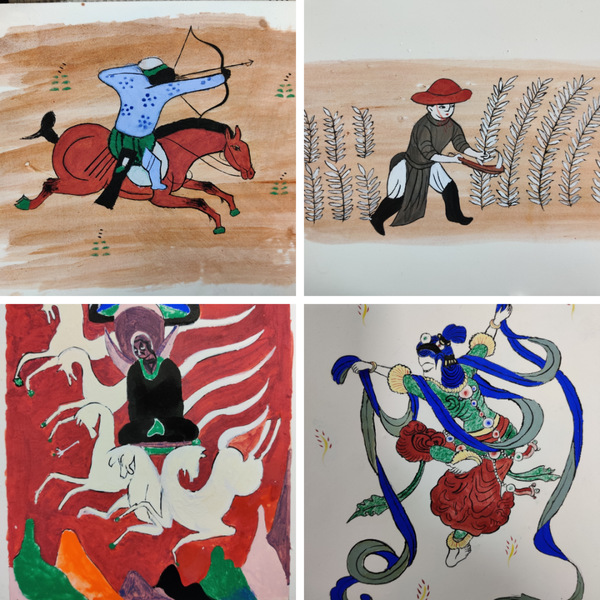
The simulated Chinese frescoes from students in Cultural Heritage Conservation Lab
A dialogue between science and art
In order to bring to life the cultural heritage through scientific techniques, the course attaches great importance to hands-on skills, which aims to bridge science and art, striking an interdisciplinary dialogue between the two.
“Though categorized into the realm of art, Cultural Heritage and Museology is in fact a major featuring real world, hands-on learning,” introduced Prof. ZHANG Hui, the course lecturer from ZJU’s School of Arts and Archaeology. “Students are required to learn experimental techniques in archaeology, including the production of simulated samples of cultural heritage, the measurement of the heritage properties, the skills of heritage conservation, and the use of common research instruments, etc.”
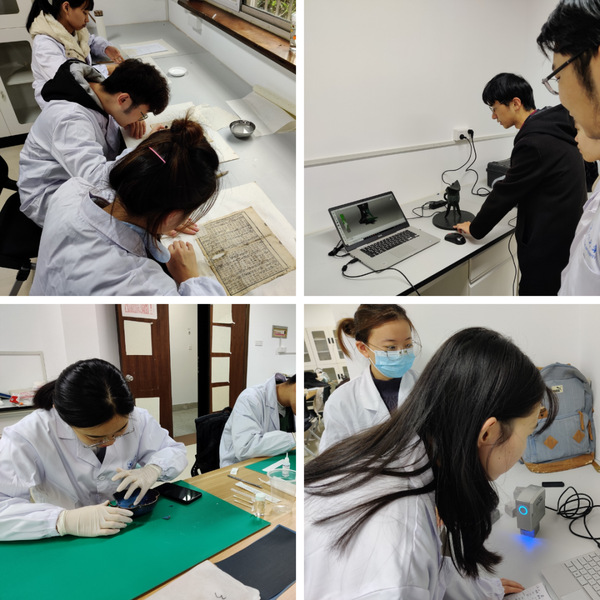
Cultural Heritage Conservation Lab in ZJU’s School of Art and Archeology
“It is an integration of humanity, art and technology,” Prof. Zhang proceeds. His words can be best exemplified by the experiment of simulating Chinese fresco, which, based upon the traditional technology of producing ancient frescos with plaster powder, also involves the use of scientific technologies like fluorescent spectroscopy and Raman spectrum analysis. With art and science both as the ground, the leaping lines were turned into colorful and vivid frescoes.
The experiments interest students to no small measure. “Those practices hone my creativity and DIY skills, laying a solid foundation for my future study in archaeology,” noted BanZhu Danta, an undergraduate in this class.
A facelift for cultural relics
In order to polish students’ crafts of heritage restoration, Prof. Zhang invited HAN Xiuli from Department of Ancient Books and Special Collection in ZJU Library and PAN Huimin from ZJU Museum of Arts and Archaeology to join the teaching team, respectively imparting students how to restore the ancient books and porcelains.
As for the restoration of the ancient books, Han instructed students to repair pages with hand-made agglomerant, a viscous paste made of wheat starch. In terms of porcelain repair, Pan guided the students step by step with plaster-mold casting, by which plaster was shaped properly to meet the cracked porcelains. Thanks to their effort, dilapidated pages and fragmentary porcelains were facelifted to be almost intact.
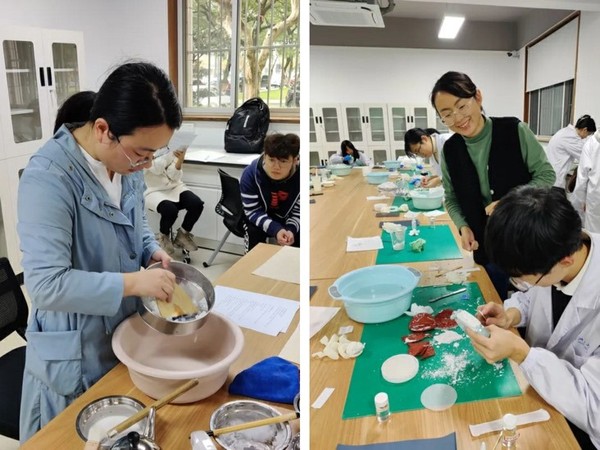
HAN (left) and PAN (right) instructed students with the experiments.
Heritage restoration requires much patience and time, during which accidents occur from time to time. “My repair process goes not so smoothly. The porcelain fragments stuck, and then fell, over and over again, so did the plaster,” told the undergraduate LIN Han. “But thanks to the patient guidance of the teachers, I eventually made it with epoxy resin,” she added in great appreciation and satisfaction.
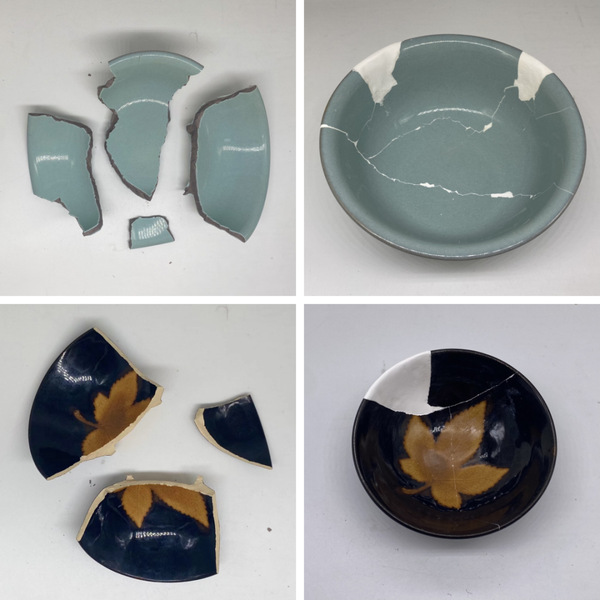
The porcelains before and after restoration
A time travel to historical scene
Out of the lab, students had the chance to perform outreach investigations at cultural relic sites, like museums, archaeological sites and heritage parks. For instance, in Liangzhu National Archaeological Heritage Park, students conducted scientific observation and non-destructive analysis on some open-air immovable cultural relics. To them, the site inspection was like a marvelous time travel and an impressive dialogue with the history as well.
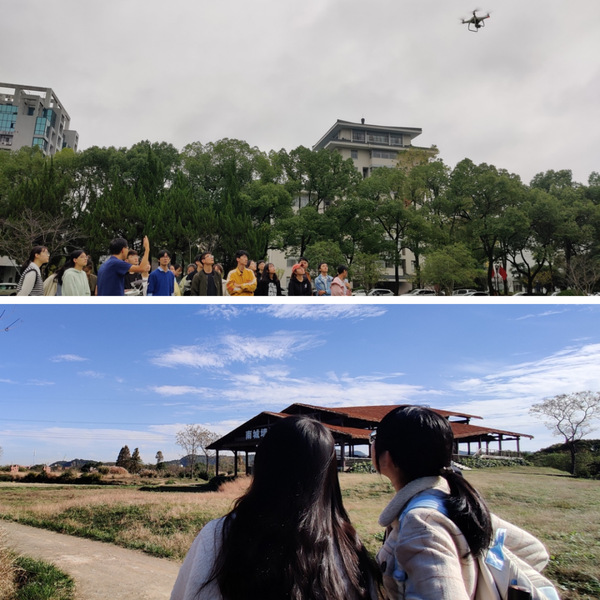
The students are learning to operate UAV at Liangzhu National Archaeological Heritage Park
“It is, comparatively, not ubiquitous for liberal-art students to conduct experiments,” told Prof. Zhang. “We set out to make a difference, hoping that experimental courses like Cultural Heritage Conservation Lab can contribute to ZJU’s construction of new liberal arts.”
Recalling the harvest of this course, many students were inspired by the way they performed experiments and began to consider their career plan with cultural heritage conservation. “I really enjoyed the practice,” said JIANG Xinyan, a Cultural Heritage and Museology major. “Through this course, I become more steadfast to launch into the conservation of cultural heritage,” she added in great determination.
Writers: LI Chenlu, SU Jingyi
Translator: ZHANG Jinmei
Photo credit: ZHANG Hui
Editor: TIAN Minjie