Insight@ZJU: Growth model of SMEs in the path of SRDI


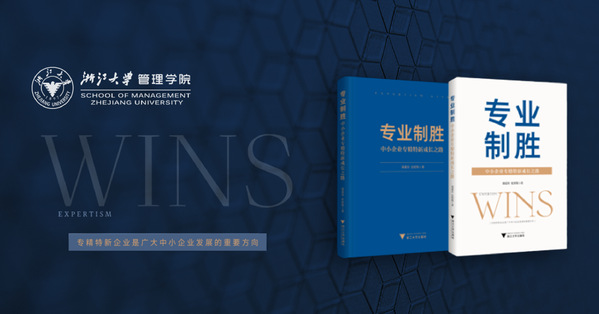
[Editor’s Note: The term SRDI (specialized, refinement, differential, innovation) was introduced at the press conference held in July 2011 pertaining to the Report on China’s Industrial Development and Policy. Since then, it has gradually turned into an everyday term for Chinese society. As Chinese small and medium-sized enterprises (SMEs) are continuously growing in size and in numbers, SRDI can serve as a compass for them, providing both guidance of the universal management theory and contextual references to the Chinese Market. So, what are the competitive advantages of SRDI enterprises and how are they created? How can SRDI enterprises achieve steady and sustainable growth? What growth model are they to adopt? Concerning these issues, Prof. WU Aiqi and Prof. SHI Yujun of Zhejiang University’s School of Management published a new book, Expertism Wins: A New Growth Road for SRDI of SMEs, which does an in-depth analysis of the growth model of SMEs in the path of SRDI, while also indicating directions for the strategic development of SMEs. In this issue of Insight@ZJU, Prof. Wu shares the story behind the book.]
The vast SMEs require efforts from academia
First of all, I did not write this book on a whim; it has been my vocation for two decades. I did my doctoral dissertation and organized three NSFC projects concerning SMEs.
SRDI enterprises are exponentially attracting social and academic attention. The existing SRDI enterprises have gradually transformed themselves by the means of specialization which motivated me to summarize previous research achievements concerning this trend, while simultaneously including the current progress SMEs are making in the marketplace.
Another intention that led me to write this book is that some SMEs have been barely surviving in the highly competitive Chinese market. As a scholar who has been constantly tracking and studying SMEs, seeing some of them at the brink of death, motivated me emotionally to find ways to help them out however I can.
Although some contents of this book may not be completely practical, the trajectories of leading enterprises like CHNT, Sunny Optical, Sanhua, and Bull have been documented, which can serve as a force of example for the majority of SMEs. As the General Secretary Xi Jinping once said, SMEs can do great things, which proves that as long we get the right ideas and right methods, high-quality SRDI enterprises will emerge.
Last but not least, I think this book was created at the right time by the right person. We have a vast number of SRDI SMEs in Zhejiang that boast distinct regional advantages, and Zhejiang University’s School of Management maintains a great rapport with many enterprises, some of which are led by ZJU’s alumni. So seeing them as our friends and classmates, who are willing to open their hearts to us and share with us their practical wisdom and experience in business, we have had a competitive edge.
We have found that many enterprises are adhering to integrity and innovation with their ordinary quality.
This book has thoroughly studied SRDI SMEs from a long-term perspective: from their formation to their future prospects. After an in-depth evaluation of 300+ national SRDI enterprises and over 2,000 non-SRDI enterprises that involved exclusive interviews, investigations, analysis, interactions, and view revisions, this book makes conclusions on the basis of horizontal and vertical comparison so as to ensure the reliability of the theories quoted in the book.
After the thorough investigation and research by my colleague Mr. SHI and I, along with our graduate and undergraduate teams, we discovered that not all enterprises have an earthshaking growth. Thus, I have once considered naming this book Return to Common Sense.
While some enterprises flow with the tide to find themselves exhausted in the process, some enterprises seem to be ordinary” while extraordinarily adhering to their ordinary-ness. In the face of actual social changes and market environment, it is rare and commendable for an enterprise and an entrepreneur to stick to their original intentions and follow the law of common sense. If these “ordinary” enterprises were to innovate, the so-called integrity and innovation can be achieved sooner.
It can be observed that some enterprises show a clear sense of self-positioning by adding their unique mission statement and intentionality to the marketplace. This seems to be why some entrepreneurs devote themselves to a specific field for decades. We have mentioned eight mechanisms applicable to the growth of SMEs in the book, which seem to be common sense but very difficult to do well. If an enterprise can do well in three or four of them, it will stand out.
Its positioned as a book that can be understood by SME entrepreneurs.
This book targets people involved in SMEs, most of whom might not understand academic terminologies. So, I have tried to make it as accessible as possible by removing a lot of complicated and obscure content, especially some academic terms, theories, and concepts.
Two decades of continuous and rigorous research have given me an understanding of the needs and the ecosystem of SMEs. To some extent, this book is my salute to SMEs. Providing this group with something they care about, and bringing them some practical reference and inspiration has always been my end goal.
Think Tank research and policy support facilitate the flexible growth of SMEs.
Many SMEs are as resilient as grassroots, an important quality to attain when the country is in the process of social and economic development. Fortunately, many government bodies strongly support the promotion and elevation of SMEs.
This brings me to my next source of innovation: Think Tank Research in the field of SRDIs that I have been engaged in for the past few years. I have participated in a series of seminars organized by the Economy and Information Technology Department of Zhejiang along with other relevant departments, while also getting involved in the cultivating and counseling work on SRDI enterprises in Wenzhou, Ningbo, Huzhou, and Shaoxing.
Comparatively speaking, this book has been integrated with some measures and practices of the government in cultivating and expanding SRDI enterprises. The last chapter of this book is about the support system of SMEs, which, although short, intends to provide ecological support for the SRDI growth of SMEs.
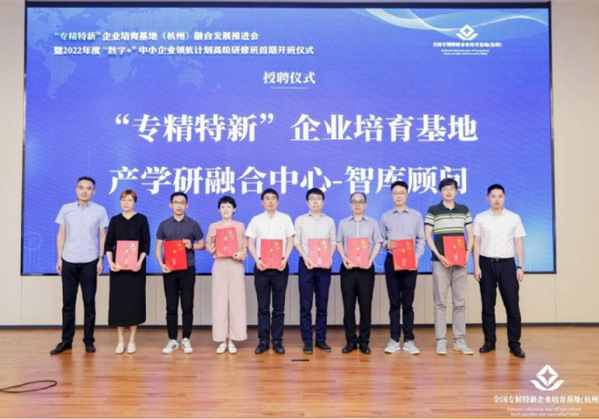
Professor WU Aiqi (fifth from the left) was Hired as the Industry-University-Research Integration Center - Think Tank Consultant of the National SRDI Enterprise Cultivation Base (Hangzhou)
Attract more college talents to devote to the traditional manufacturing industry and Chinas SMEs.
We brought together some graduate and undergraduate students for the investigation and research for this book, as we were certain these students understood that Chinese enterprises such as the intelligent manufacturing industry are in the process of transformation and refurbishment, which, different from the former impression of roaring machines and flying dust, is replaced by specialization and modernization.
I expect more outstanding students to take interest in the manufacturing industry and devote themselves to Chinas SMEs after these informational and educational enterprise visits.
Source: School of Management, Zhejiang University
This article reflects the author's opinions and not necessarily those of Zhejiang University.