Scientists propose groundbreaking interpersonal computational framework for impairments in social coordination


Research teams led by Prof. CHEN Ji and Prof. PAN Yafeng from Zhejiang University’s Department of Psychology and Behavioral Sciences, joined forces with the research team led by Dr. JIN Jingwen from the Department of Psychology at the University of Hong Kong in their research on schizophrenia. Their groundbreaking work, titled “The interpersonal computational psychiatry of social coordination in schizophrenia”, was recently published in The Lancet Psychiatry, a top journal in the field of psychiatry.
This comprehensive review paper introduces a novel theory and model of interpersonal computational psychiatry, specifically focusing on individuals with schizophrenia. By leveraging a joint finger-tapping paradigm, the researchers integrated dynamical systems modeling with the active inference framework to dissect the cognitive processes and neural mechanisms that underlie aberrant social coordination.
Social interactions, which are a core element of social functioning, encompass a wide range of interchanges between individuals in various forms within a social context. Disorders affecting social cognition and interpersonal interactions share common features across diagnostic categories. Particularly in conditions like schizophrenia and autism, these anomalies are closely linked to patient prognosis. Thus, deciphering the cognitive processes and neural mechanisms underlying these aberrant interpersonal behaviors holds immense scientific and clinical significance.
Schizophrenia is marked by positive symptoms such as hallucination and delusion as well as negative symptoms like social withdrawal and blunted affect. Theories rooted in predictive coding have provided substantial insights into the generation of positive symptoms, backed by a massive body of empirical research. However, the theoretical frameworks for negative symptoms remain relatively underdeveloped. Investigation into the abnormal patterns of interpersonal interactions promises to illuminate the origins of these negative symptoms. Given the distorted perceptions of the real world inherent in schizophrenia patients, schizophrenia stands as an ideal clinical model for probing cognitive impairments and aberrant behaviors.
Previous studies exploring abnormal interpersonal interactions in psychiatric disorders remain primarily within the realm of phenomenology (e.g., reaction times, synchrony), while research grounded in theoretical models like Bayesian approaches is often confined to individual paradigms, overlooking the essence of social interactions. The framework of interpersonal computational psychiatry proposed by Prof. CHEN Ji et al. addresses this gap by focusing on two core aspects: 1) leveraging the active inference framework to model aberrant social coordination processes in schizophrenia and 2) incorporating dynamic system models to dissect intrapersonal and interpersonal synchronization to inform a statistical model based on active inference.
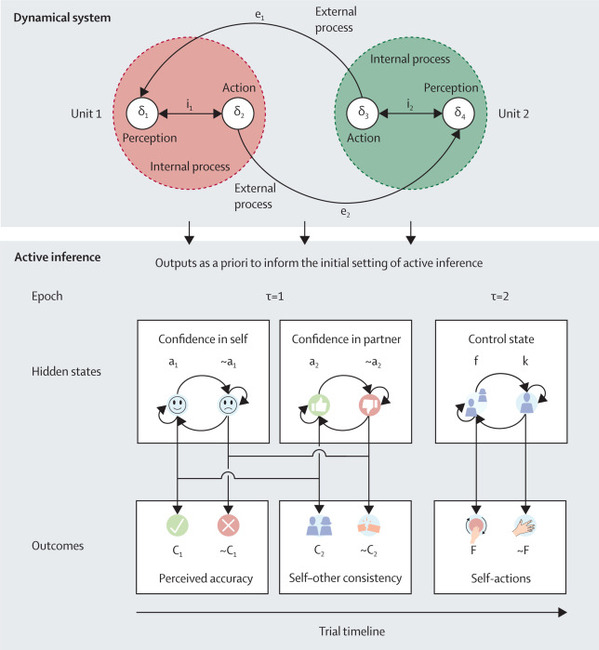
Interpersonal computational psychiatry model integrating dynamical systems and active inference
The interaction strategies extracted from dynamic system models act as constraints, enriching the architecture of active inference models. Furthermore, deviations in cognitive processes can manifest in distinct symptomatology, such as different components of positive and negative symptoms. Therefore, unraveling these biased cognitive processes helps deepen our understanding of aberrant social interactions and related psychopathology.
This collaborative effort marks a leap forward in computational psychiatry, offering fresh insights into the intricacies of social coordination impairments in schizophrenia. The integration of dynamical systems modeling and active inference could lay the groundwork for the development of targeted behavioral interventions and multi-person neuromodulation strategies.