ZJU scientists illustrated the regulatory mechanism of silk gene expression


The sericulture industry holds a rich and enduring history in China, deeply intertwined with the ancient Silk Road, a significant trade route that facilitated the widespread expansion of Chinese silk across Eurasia. This historical context allowed for profound cultural exchange between the East and the West. Central to this industry is the domestic silkworm, renowned for its exceptional silk production capability. The characteristics of silk-spinning directly impact the quality and quantity of silk yielded. Consequently, extensive research efforts have been dedicated to enhancing both the production and quality of silkworm silk.
In recent scientific explorations, the application of insect juvenile hormone analogs has shown promise in augmenting the synthesis of silk proteins. However, the specific mechanism underlying this phenomenon has remained elusive. In the past few years, researchers have increasingly turned their focus to N6-methyladenosine (m6A) modification of RNA, recognizing its pivotal role in the growth and development of eukaryotic organisms. Despite its significance, there exists a scarcity of research concerning the role and mechanism of m6A in the physiology of domestic silkworms.
Addressing this gap, a research team led by WANG Huabing from the Zhejiang University College of Animal Sciences conducted a comprehensive evolutionary analysis of m6A-related genes across more than 200 insect species. Their work not only confirmed the evolutionary conservation of m6A-related genes but also illuminated their critical function in the embryonic development of domestic silkworms. More recently, the team delved deeper into the vital role of m6A modification in regulating silk synthesis. Their groundbreaking findings were published in a research article titled “Juvenile hormone regulates silk gene expression by m6A RNA methylation” in the esteemed journal Cellular and Molecular Life Sciences, shedding new light on the intricate mechanisms governing silk production in domestic silkworms.
Through the administration of various hormones to domestic silkworms and the subsequent conduct of transcriptome analyses, the researchers were able to discern the hormone-specific regulation of m6A-related genes, specifically METTL3 and YTHDF3, within the posterior silk gland of domestic silkworms. This discovery shed light on the intricate mechanism of m6A modification orchestrated by juvenile hormones. Employing MeRIP sequencing analysis, the researchers observed the pervasive presence of m6A modifications on mRNAs within the posterior silk gland, influencing critical processes such as mRNA translation, degradation, and splicing. Particularly noteworthy was the substantial enrichment of genes exhibiting distinct m6A modifications after exposure to juvenile hormones, notably within pivotal pathways such as the Wnt signaling pathway and the autophagy pathway. This observation underscored the significant role of juvenile hormones in orchestrating the activity of these pathways through the intricate process of m6A modifications.
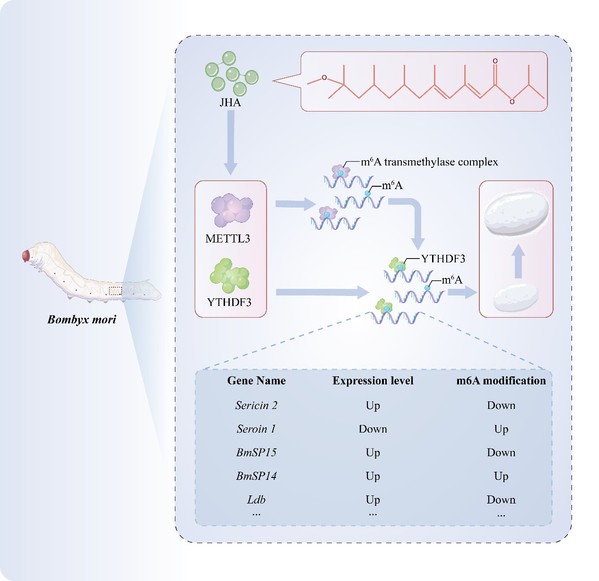
Graphical abstract
The posterior silk gland, a pivotal organ in silk protein synthesis, plays a crucial role in silk production. By integrating data from transcriptome and MeRIP sequencing, researchers discerned alterations in m6A modifications and patterns in the expression of genes associated with silk protein synthesis in response to juvenile hormone treatment. This investigation revealed significant variations in the expression of 16 silk protein-associated genes, with 11 of them notably influenced by METTL3 knockdown, affirming their status as targets of m6A modifications. Additionally, employing a transient expression silk protein gene vector, coupled with MeRIP data for mutating m6A modification sites, transfection into domestic silkworm ovary cells, and subsequent expression detection, the researchers illustrated that m6A modification sites in the CDS region serve as mediators for the regulatory impact of juvenile hormone on silk protein-related genes.
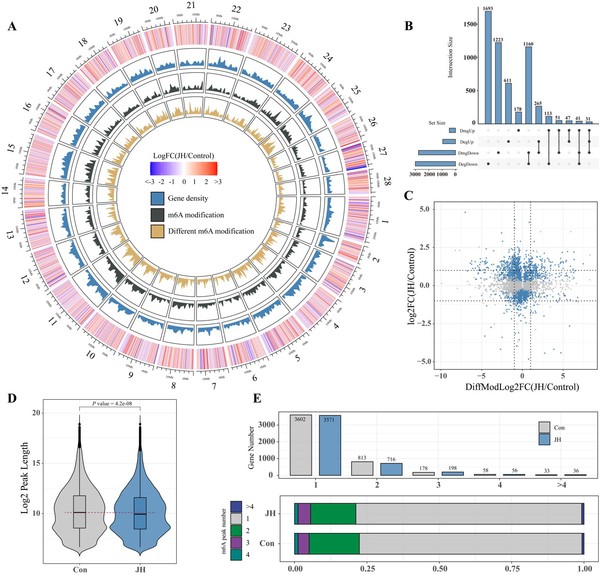
Juvenile hormone regulates silk gene expression by m6A RNA methylation
This study not only illuminates the vital biological role of m6A in the posterior silk gland but also unveils its mediation of juvenile hormone regulation on the expression of silk protein-associated genes. Furthermore, it offers novel insights into the exploration of epigenetics and the hormone response-related regulatory network in domestic silkworms, thereby holding theoretical implications for silk production.