ZJU professors publish insightful study on interprovincial food trade and land scarcity


On January 8, 2024, Professors ZHANG Weiwen and FANG Kai from the School of Public Affairs at Zhejiang University, as joint corresponding authors, published a significant paper titled “Interprovincial food trade aggravates China’s land scarcity” in Humanities and Social Sciences Communications. The study reveals the complex impact of interprovincial food trade on virtual scarce land flow patterns and its intricate effects on the land scarcity in food import and export regions across China. Collaborators in this research include experts from Tsinghua University, Vrije Universiteit Amsterdam, Chongqing University, and Neijiang Normal University.
The paper delves into the increasing scarcity of land, a vital resource for achieving many Sustainable Development Goals (SDGs). It examines the imbalance between cropland availability and demand, exploring how the trade of agricultural products might alleviate or exacerbate this issue. By integrating grid-level cropland data into a multi-regional input-output analysis, the study provides a detailed account of China's scarce land footprint and virtual scarce land flows at a high resolution of 1 km × 1 km.
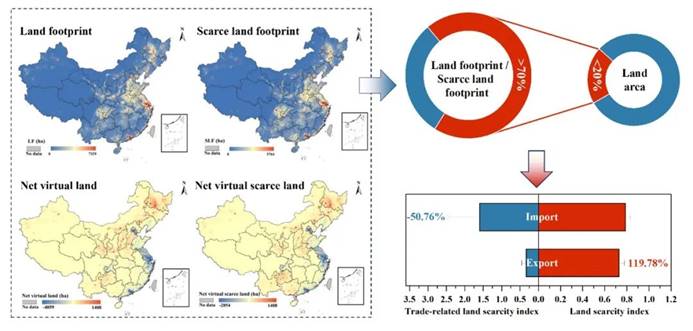
The results are revealing: over 70% of China's land footprint and scarce land footprint are concentrated in less than 20% of the land, with nearly 38% of these hotspot clusters crossing provincial borders. The study finds that while virtual land trade reduces land scarcity in land-importing provinces by 50.8%, it significantly increases it in land-exporting provinces by 119.8%.
These findings challenge existing views on food trade, suggesting a need for new policies that better manage land resources and promote collaborative governance beyond administrative boundaries. The study underscores the critical need to consider land scarcity and suggests integrating it into environmental footprints to support the SDG framework more effectively.