Role of hydrodynamics for spatial distribution of biological communities in deep ocean


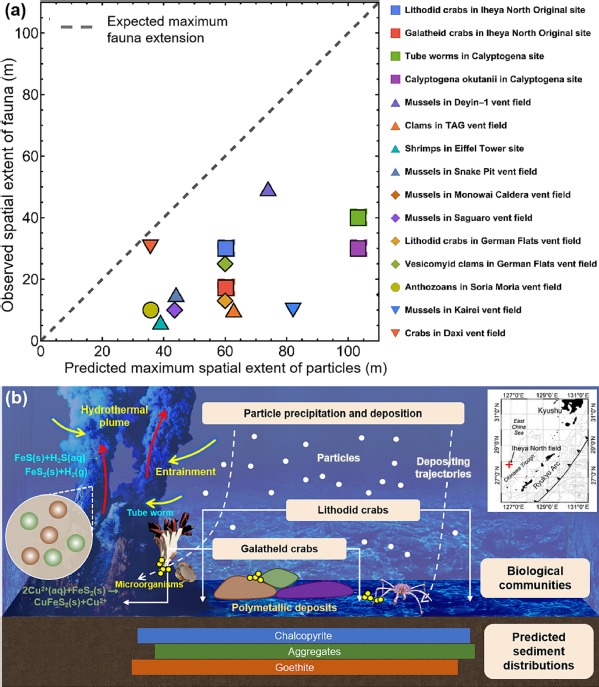
Active hydrothermal vents provide the surrounding submarine environment with substantial amounts of matter and energy, thus serving as important habitats for diverse megabenthic communities in the deep ocean and constituting a unique, highly productive chemosynthetic ecosystem on Earth. Vent-endemic biological communities gather near the venting site and are usually not found beyond a distance of the order of 100 m from the vent. This is surprising because one would actually expect matter ejected from high-temperature vents, which generate highly turbulent buoyancy plumes, to be suspended and carried far away by the plume flows and deep-sea currents. ZJU researchers studied this problem from a fluid dynamics perspective. They found that both low- and high-temperature vents deposit most vent matter relatively close to the plume. In particular, the tendency of turbulent buoyancy plumes to carry matter far away is strongly counteracted by generated entrainment flows back into the plume stem. The deposition ranges of organic and inorganic hydrothermal particles obtained from the simulations for various natural high-temperature vents are consistent with the observed maximum spatial extent of biological communities, evidencing that plume hydrodynamics exercises strong control over the spatial distribution of vent-endemic fauna.