Why certain students excel in math: ZJU scientists unlock this mystery


Learning is undeniably one of the most crucial skills for human beings, prompting many parents to find answers to such questions like “how can children learn more easily” and how can they learn better and faster.”
To address this quest for effective learning strategies, Professor CHEN Feiyan from the Zhejiang University School of Physics and Professor Vinod Menon from the Stanford University School of Medicine delved into research on the neural mechanisms of learning.
“Math forms the cornerstone of development across various industries, and children’s early math abilities often impact their future development,” explained CHEN Feiyan.
The research team embarked on a comprehensive five-year longitudinal study involving elementary school aged children to explore the neural underpinnings of learning, particularly in math. The study focused on analyzing data from the abacus-based mental calculation (AMC) training group, shedding light on why some individuals excel in math learning under similar conditions.
In addition to regular math classes, children in the AMC group underwent 2-hour weekly sessions of AMC training while the control group were provided with additional learning of conventional study materials, such as calculation and reading, for the equivalent duration as additional learning of abacus in the AMC group. The two groups were comparable in age, gender, and cognitive abilities. Subsequently, the research team evaluated the long-term learning outcomes by assessing the children's math proficiency from second to fifth grade.
“Results revealed a significant difference in math abilities between the AMC and the control groups, with the former exhibiting notably higher average scores and learning rates,” said XIE Ye, one member on the team. However, within the AMC group, there were discernible individual differences in learning outcomes, prompting further investigation into the underlying mechanisms.
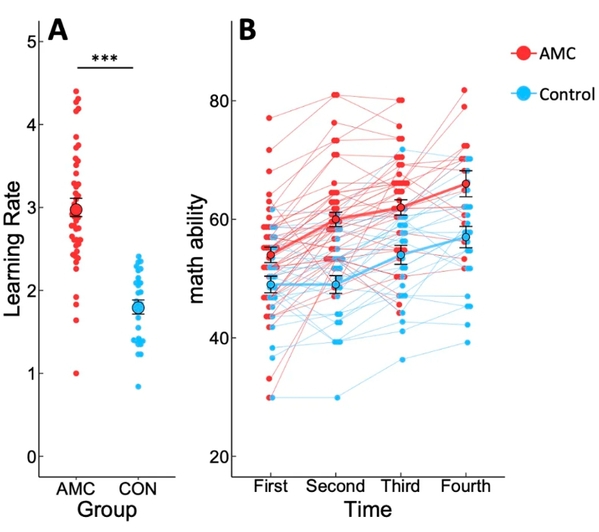
Fig.1: The AMC training group showed higher learning gains in math ability than the control group.
Through safe and non-invasive MRI scans conducted with parental consent, the research team identified structural and functional differences associated with math learning. Specifically, they found that the volume of gray matter in the bilateral hippocampus and its adjacent medial temporal lobe predicted the learning rates of math ability in AMC children over four years.
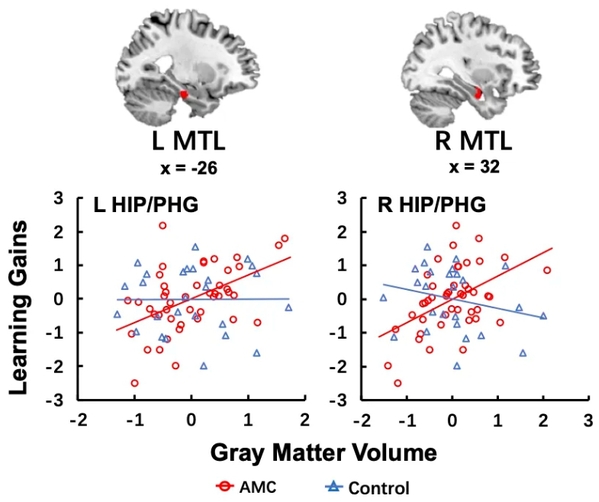
Fig.2: Gray matter volume of medial temporal lobe (MTL) regions predicts learning rates in math ability in the AMC group.
If gray matter were likened to the hardware of a computer, then the synchronous brain activities would constitute the functional connectivity between brain regions, collectively forming different “operating systems.”
The researchers further explored the functional connectivity of the brain during children’s resting state and found that the “operating system” of the brain could also predict individual math learning—the synchronous brain activity between the bilateral hippocampal system and the frontal and ventral temporal-occipital cortices could predict the learning rate of subsequent math abilities in AMC children.
These findings indicate that the more the information exchange between the bilateral hippocampal system and other brain regions involved in math learning, the greater learning outcome AMC children can achieve.
“This study re-verifies that the hippocampal neural system deep in the brain, which is closely related to memory and learning, can provide impetus for long-term skill acquisition,” said XIE Ye.
This five-year longitudinal study reveals that after a year of AMC training, the hippocampal system augments the integration of specific information to back up subsequent long-term learning through information exchange with brain regions related to math learning. This also indicates that continuous learning can trigger persistent specific plasticity in the brain system, thus enhancing the effectiveness of learning—a concept reminiscent of “the more one uses their brain, the better it gets.”
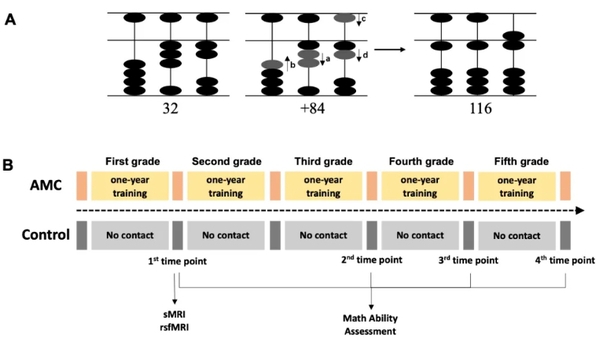
Fig.3: Sample abacus calculation procedure and the study design.
The interdisciplinary approach to integrating physics, cognitive neuroscience, psychology, and neuroscience offers promising implications for pedagogical practices and cognitive training. CHEN Feiyan highlighted the value of interdisciplinary research, emphasizing the analytical and modeling power derived from physics in understanding complex learning mechanisms.
More information: Ye Xie, et al. Long-term abacus training gains in children are predicted by medial temporal lobe anatomy and circuitry, Developmental Science (2024) https://onlinelibrary.wiley.com/doi/10.1111/desc.13489