What do quantum cognition, quantum consciousness, and quantum brains have to do with each other?


Time: 9:30
Venue: Zijingang Campus
Speaker: Jerome Busemeyer
Category: Talk & Lecture
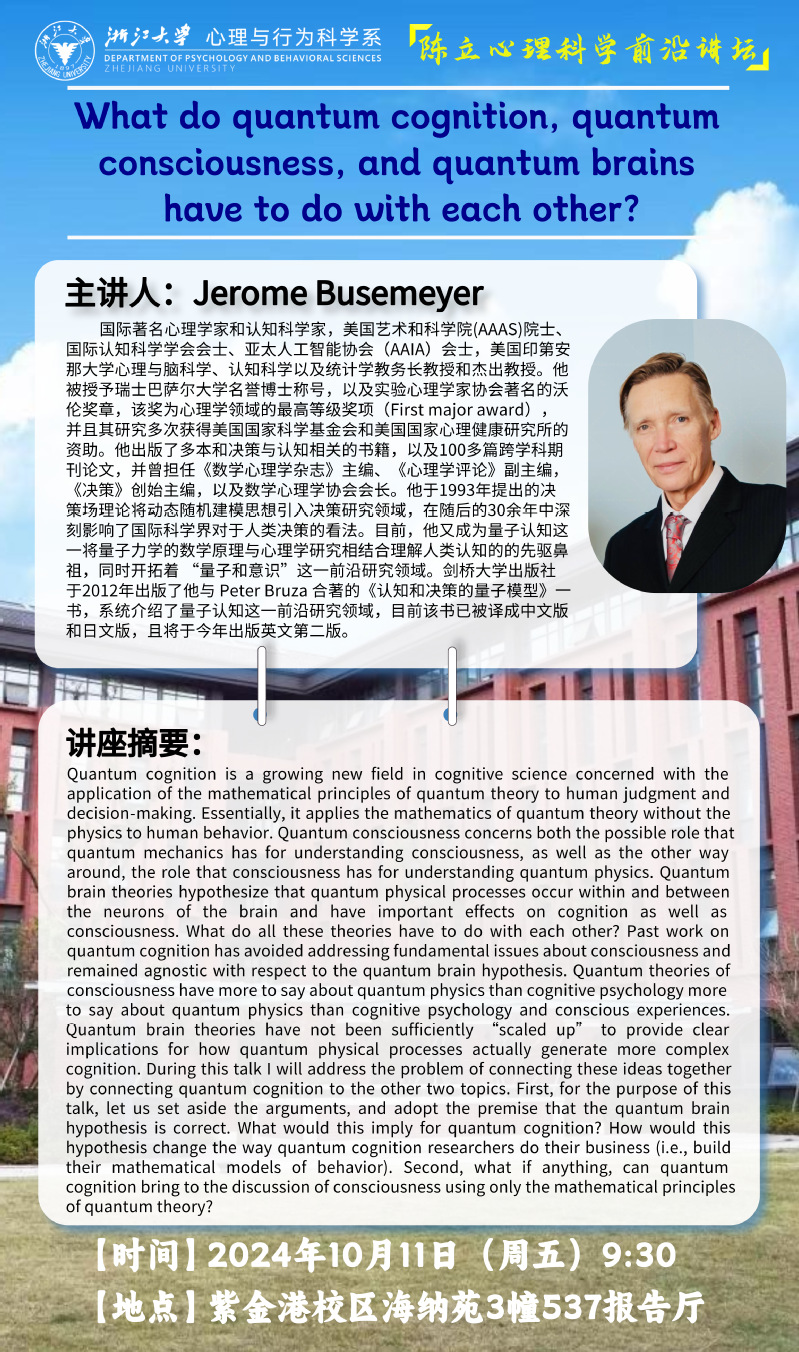
Speaker: Jerome Busemeyer
Venue: 537, No.3 Haina Building
Abstract: Quantum cognition is a growing new field in cognitive science concerned with the application of the mathematical principles of quantum theory to human judgment and decision-making. Essentially, it applies the mathematics of quantum theory without the physics to human behavior. Quantum consciousness concerns both the possible role that quantum mechanics has for understanding consciousness, as well as the other way around, the role that consciousness has for understanding quantum physics. Quantum brain theories hypothesize that quantum physical processes occur within and between the neurons of the brain and have important effects on cognition as well as consciousness. What do all these theories have to do with each other? Past work on quantum cognition has avoided addressing fundamental issues about consciousness and remained agnostic with respect to the quantum brain hypothesis. Quantum theories of consciousness have more to say about quantum physics than cognitive psychology more to say about quantum physics than cognitive psychology and conscious experiences.Quantum brain theories have not been sufficiently "scaled up"to provide clear implications for how quantum physical processes actually generate more complex cognition. During this talk I will address the problem of connecting these ideas together by connecting quantum cognition to the other two topics. First, for the purpose of this talk, let us set aside the arguments, and adopt the premise that the quantum brain hypothesis is correct. What would this imply for quantum cognition? How would this hypothesis change the way quantum cognition researchers do their business (i.e., build their mathematical models of behavior). Second, what if anything,can quantum cognition bring to the discussion of consciousness using only the mathematical principles of quantum theory?
