Bridging cultures: Professor LI Yuan honored with the Goethe medal in Germany


Professor LI Yuan from the School of International Studies, Zhejiang University (ZJU), has been awarded the Goethe Medal, a prestigious honor granted by the German government to individuals who have made outstanding contributions to international cultural exchange. Recognized for her pioneering work in German language education and her role in strengthening China–Germany dialogue, Professor Li exemplifies ZJU’s commitment to global engagement and academic innovation.
From Corpus to AI Tutor
Since 2019, Professor LI has devoted herself to advancing research and practice in German language education. She led her team in establishing the world’s largest corpus of Chinese learners of German, collaborating with institutions nationwide to collect and analyze authentic learner data. Built to international standards, this corpus provides valuable empirical evidence for foreign language acquisition research and offers high-quality data for large language model development.
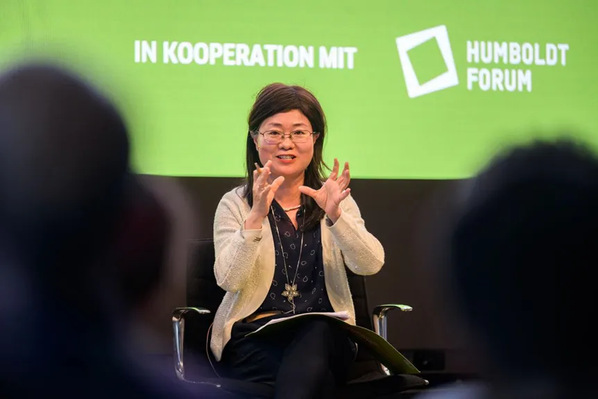
Building upon this foundation, Professor LI joined forces with ZJU’s artificial intelligence experts to develop Dr. Write, an intelligent writing feedback system tailored to the needs of German learners. Through interactive, multi-round feedback, the system encourages students to reflect, revise, and think critically—transforming writing from a source of anxiety into a process of discovery. Students describe Dr. Write not merely as a digital tool but as an “intelligent tutor” that provides personalized, insightful guidance.
‘pie’: Passion, indomitable, excellence
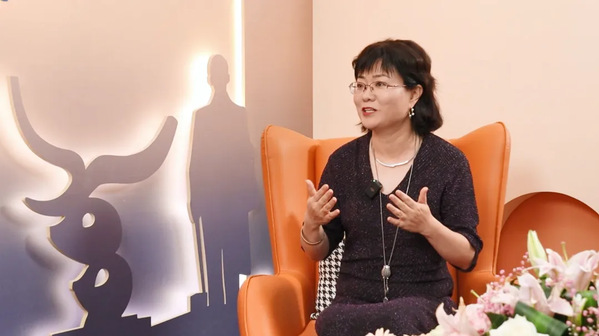
Guided by the principles of “passion, indomitable spirit, and excellence” (pie), Professor LI has built a teaching philosophy that empowers students to grow both intellectually and personally. She integrates the spirit of German academic discussion into her classrooms, fostering critical inquiry and open dialogue. In her view, language education extends beyond communication skills—it cultivates cross-cultural understanding, critical thinking, and independent learning. Many of her students attest that her teaching has not only strengthened their linguistic abilities but also shaped their worldview and inspired their academic journeys.
Bridging Chinese and German Cultures
Beyond her teaching and research, Professor Li plays an active role in promoting Sino-German educational and cultural collaboration. She has organized national symposiums on German language teaching, supported professional training for educators, and edited a series of bilingual textbooks that help students better understand and articulate the connections between Chinese and German cultures.
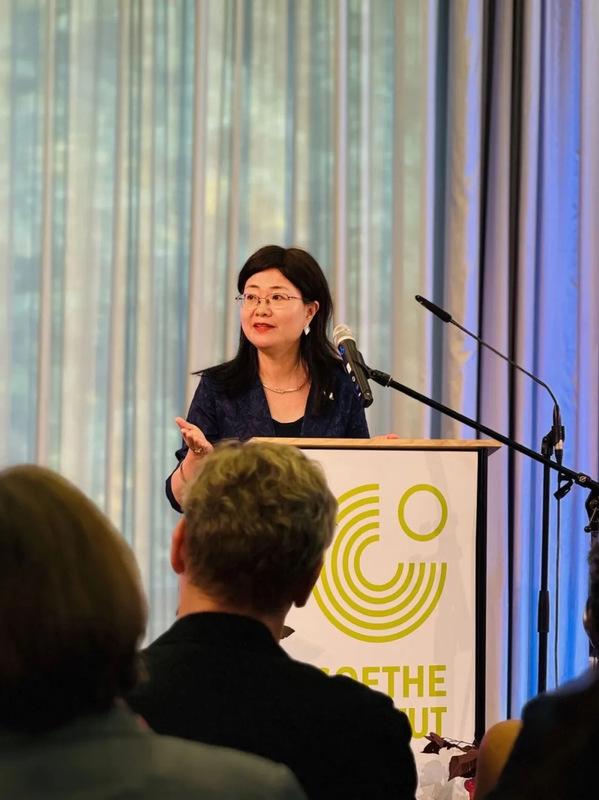
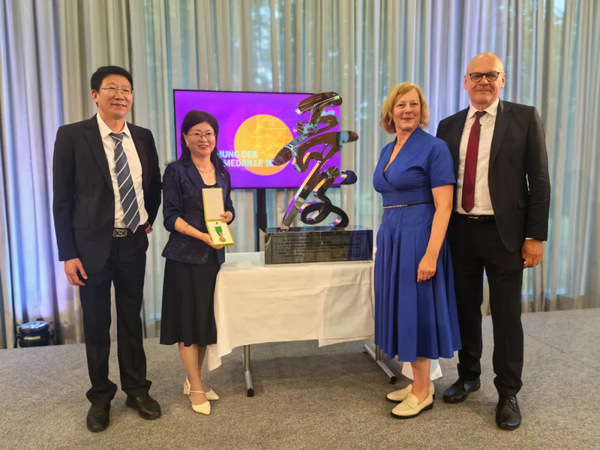
At the Goethe Medal award ceremony, Gesche Joost, President of the Goethe-Institut, praised Professor LI for “building bridges between cultures through the German language and fostering mutual understanding among societies.” Professor LI remarked that the award “is not only a personal honor, but also a recognition of the collective efforts of Chinese scholars in German studies and the growing international presence of China’s foreign language education.”
As a symbolic gesture, she presented the Goethe-Institut headquarters with a calligraphy sculpture titled “Love’. The word’s pinyin “AI”—echoing the abbreviation for “artificial intelligence”—reflects her belief in uniting technology and humanistic values. This gift embodies both her interdisciplinary vision and ZJU’s dedication to openness, creativity, and cultural exchange.
Professor LI’s journey represents Zhejiang University’s broader vision for fostering global understanding through education. By building linguistic and cultural bridges, she demonstrates that meaningful communication is never one-way, but rather a shared pursuit of empathy and insight. In a world shaped by globalization and technological transformation, scholars like LI Yuan continue to connect people and ideas—helping cultures meet, learn, and grow together.
Adapted and translated from the article written by WU Wenbo, ZHANG Shufan
Translator: WU Jingying (27',Communication)
Photo: ZHU Yaokun
Editor: HAN Xiao