Zhejiang University claims the IndySCC title after 46-hour cloud showdown


With just 46 hours on the clock and only a handful of virtual machines to work with, Zhejiang University’s supercomputing team set out to do what high-performance computing is built for: push limited resources to their limit and still deliver the best possible results.
They made it. Competing in the IndySCC online track, one of the headline events tied to the SC supercomputing conference, the team outperformed strong contenders from leading universities around the world, including Peking University and Tsinghua University, to take the global championship. It marks ZJU’s second IndySCC title, following their 2023 win, making them the only team from a Chinese university to have claimed the crown twice.
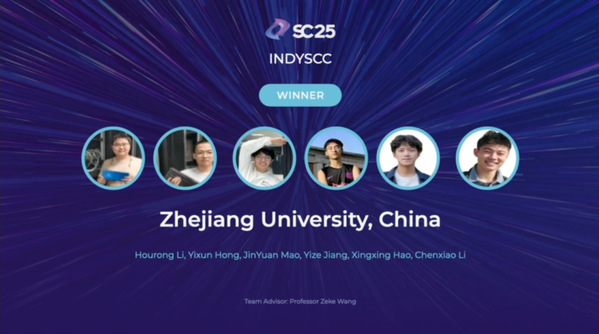
The IndySCC is a remote, cloud-based competition that runs parallel to the Student Cluster Competition (SCC). The challenges span four major areas: the HPL benchmark test, climate simulation, system simulation, and high-energy physics. They are designed to test teams’ ability to collaborate and optimize complex applications under severe time pressure.
“The moment the competition started, we had to squeeze every last bit out of five virtual machines,”said team leader LI Chenxiao, a computer science undergraduate from the Class of 2026. “It wasn’t just about solving problems; it was about scheduling.”
That scheduling problem is what makes the IndySCC uniquely punishing. Because the contest runs entirely in the cloud, teams don’t need to build a physical cluster—no shipping hardware, no on-site setup. But the standardized virtual environment raises a different question: who can learn the platform fastest, find performance bottlenecks first, and turn that knowledge into points before time runs out?
The countdown began at 9 a.m. From then, the next 46 hours became a test of endurance and of strategy.
Alongside routine optimization tasks, the IndySCC includes a “mystery problem” revealed only at the start of the competition. This year’s surprise challenge was ACTS, a high-energy physics tracking reconstruction program. With limited computing nodes available, the ZJU team quickly adopted a “no-idle” approach: the scarce H100 GPU node was reserved for the GPU-heavy task ECE, while the CPU-based task SST was threaded into the remaining machines whenever possible. The mystery problem, meanwhile, was initially trial-run on the weakest node, enough to validate the workflow while more powerful resources were tied up elsewhere.
Throughout the contest, the team monitored a live utilization dashboard. When one task finished, another had to take its place immediately. In their view, even a second of downtime was too expensive.
Unexpected issues still surfaced. MAO Jinyuan, a sophomore majoring in business big data analytics, was responsible for the SST task. He spotted a small but consequential gap in the official materials early in the competition. The team contacted the organizers right away and received a corrected file in time to adjust their approach. “In a supercomputing competition where every second counts, timely feedback and fixes can make a real difference,” he said.
The biggest pressure point came with the mystery task. To maximize their score, LI Chenxiao kept the job running until the final moments before the U.S.-time submission deadline, aiming to produce as many valid data points as possible. When the upload bar finally reached 100% at around 7 a.m., the team’s 46-hour sprint ended the only way they wanted it to: with a win.
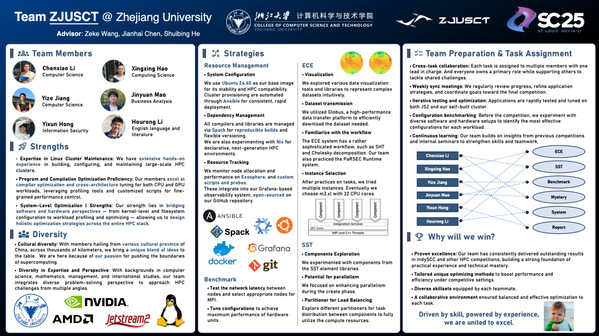
Team members credit more than tactics and stamina. They point to the spirit of “seeking truth”—ZJU’s long-standing ethos of steady, evidence-driven work.
“When we hit hard problems, we’re willing to work through them step by step and fix the code properly,” said HONG Yixun, a second-year college student majoring in information security. With minimal documentation for the ACTS task, the team chose not to hunt for shortcuts. Instead, they manually organized data, compiled dependencies one by one, and iterated carefully until the program ran reliably. The approach was time-consuming, but it helped them become one of the first teams to get the pipeline fully running and they ultimately posted the highest completion level on that task.
That same mindset is interwoven into the whole team-building process.
ZJU’s supercomputing team recruits across majors, welcoming any student with an interest in high-performance computing. Moreover, the team relies on a strong “mentoring chain” in which older members coach new recruits. Advisor WANG Zeke said the team has built an integrated system that connects coursework, hands-on lab practice, weekly progress meetings, and competition experience into a single pipeline. Just as importantly, he added, team members are expected to share what they learn rather than keep techniques to themselves.
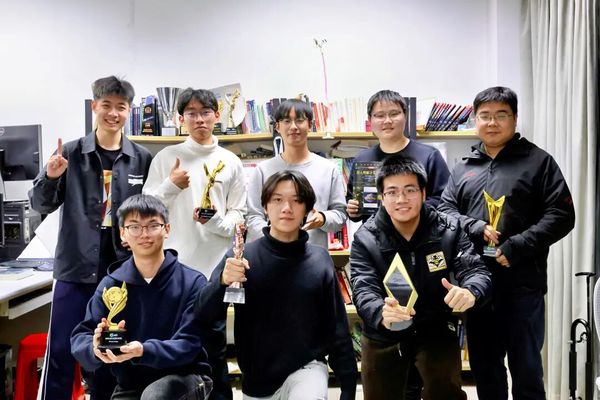
If the team had to sum up its competitive identity in one word, members say it would be “extreme”, as in extreme efficiency. In competition, that means squeezing every bit of performance out of limited time, limited hardware, and limited room for error.
But WANG Zeke argues that the larger goal sits beyond contests. Many IndySCC-style tasks are rooted in basic sciences, say physics, chemistry, biology, where researchers may have sophisticated models but lack the HPC optimization experience needed to run large-scale computations efficiently. For the students, competition problems like DeePMD (for molecular dynamics) and 3DMHD (for magnetohydrodynamics) are more than enigmas; they’re training for real research support.
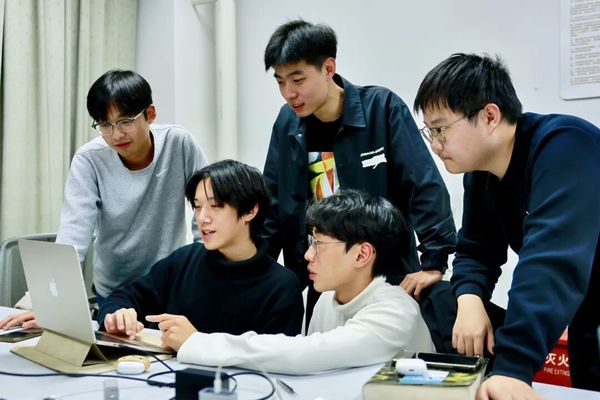
The team is now working to translate its competition-hardened tuning methods into repeatable tools and workflows that can serve multidisciplinary research, turning “race-day” optimizations into everyday acceleration for scientific discovery.
“Stay hungry, stay foolish,” said LI Hourong, a second-year English major on the team, borrowing Steve Jobs’ famous line to describe the group’s culture. In a field where the boundary of computing power keeps moving, the ZJU supercomputing team is betting that curiosity and relentless execution will keep them moving with it.
Translator: FANG Fumin
Editor: HAN Xiao