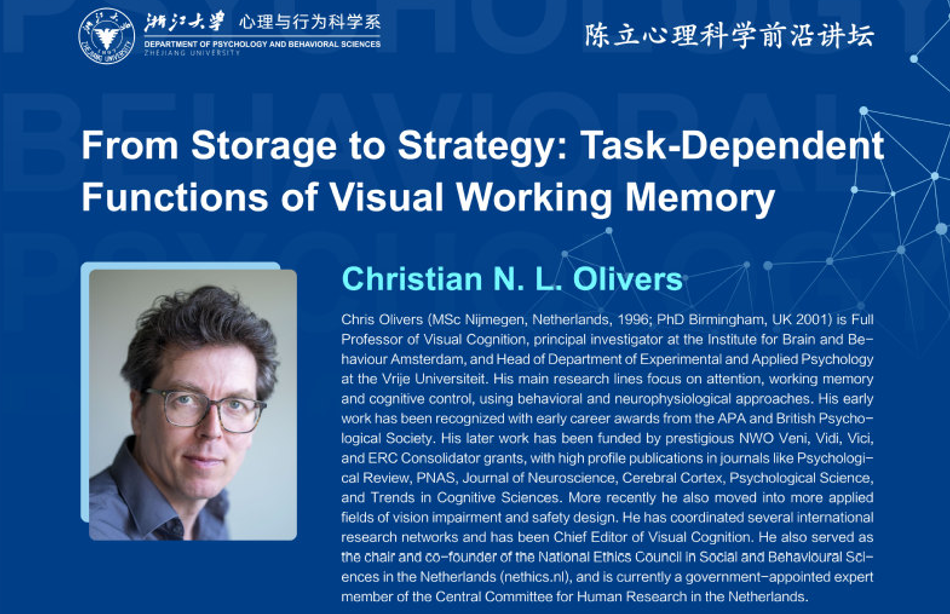
From storage to strategy: task-dependent functions of visual working memory


Time: 10:00
Venue: Zijingang Campus
Speaker: OLIVERS Christian
Category: Talk & Lecture
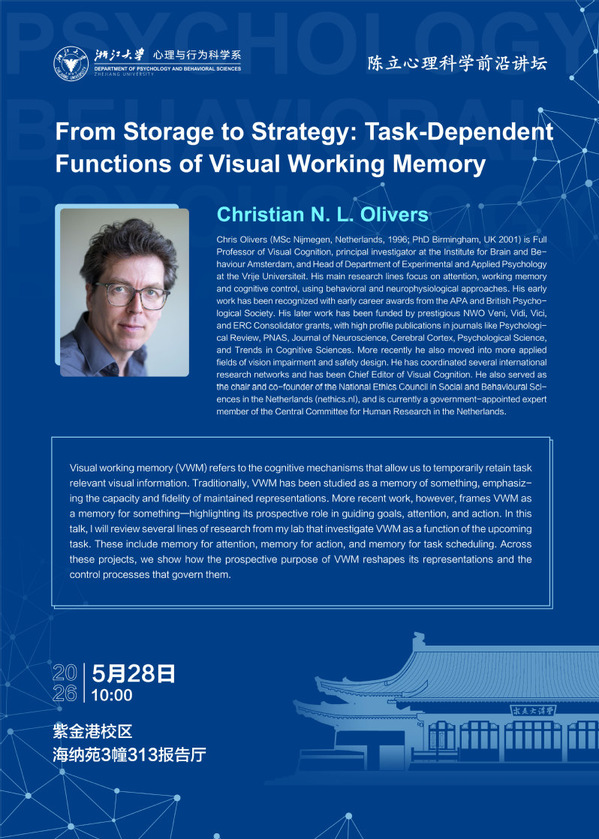
Speaker: Christian Olivers
Venue: Room 313, Haina Building 3, Zijingang Campus
Abstract: Chris Olivers (MSc Nijmegen, Netherlands, 1996; PhD Birmingham, UK 2001) is Full Professor of Visual Cognition, principal investigator at the Institute for Brain and Behaviour Amsterdam, and Head of Department of Experimental and Applied Psychology at the Vrije Universiteit. His main research lines focus on attention, working memory and cognitive control, using behavioral and neurophysiological approaches. His early work has been recognized with early career awards from the APA and British Psychological Society. His later work has been funded by prestigious NWO Veni, Vidi, Vici, and ERC Consolidator grants, with high profile publications in journals like Psychological Review, PNAS, Journal of Neuroscience, Cerebral Cortex, Psychological Science, and Trends in Cognitive Sciences. More recently he also moved into more applied fields of vision impairment and safety design. He has coordinated several international research networks and has been Chief Editor of Visual Cognition. He also served as the chair and co-founder of the National Ethics Council in Social and Behavioural Sciences in the Netherlands (nethics.nl), and is currently a government-appointed expert member of the Central Committee for Human Research in the Netherlands.
Visual working memory (VWM) refers to the cognitive mechanisms that allow us to temporarily retain task relevant visual information. Traditionally, VWM has been studied as a memory of something, emphasizing the capacity and fidelity of maintained representations. More recent work, however, frames VWM as a memory for something—highlighting its prospective role in guiding goals, attention, and action. In this talk, I will review several lines of research from my lab that investigate VWM as a function of the upcoming task. These include memory for attention, memory for action, and memory for task scheduling. Across these projects, we show how the prospective purpose of VWM reshapes its representations and the control processes that govern them.