Molecular catchers offer breakthrough in determining elusive compound structures


Determining a molecule’s structure is fundamental to chemistry, akin to giving it a passport or a fingerprint. Without a clear structural ID, scientists can’t fully understand what a compound is or how it works. But some molecules, especially those with long, flexible alkyl chains, have remained frustratingly difficult to analyze with standard methods.
Now, the research team led by Professor HUANG Feihe from the Zhejiang University Department of Chemistry has developed a powerful new technique that helps “register” these elusive compounds. The method, dubbed “supramolecular docking”, employs a “molecular catcher” — a supramolecular macrocyclic metal-organic framework (MOF) — to specifically recognize long alkyl chain compounds and systematically determine their single-crystal structures, successfully “registering” previously unidentified compounds. The work was published in Nature on April 9.
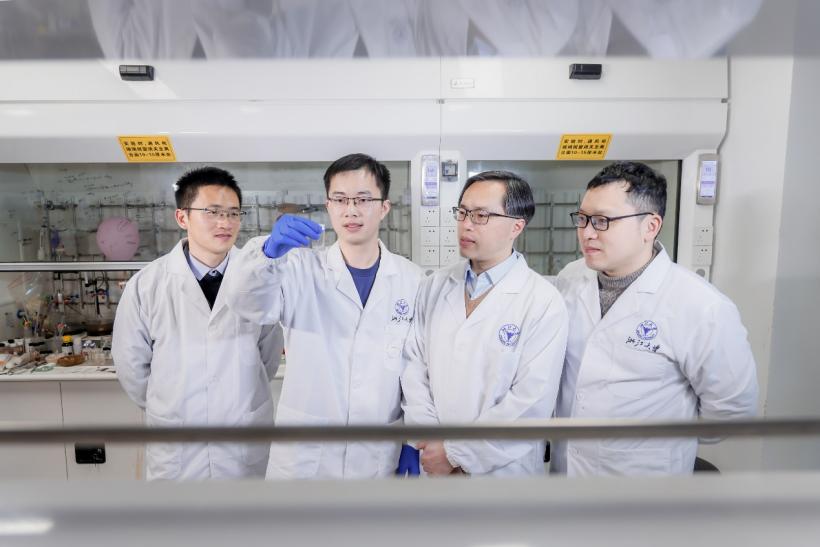
Professor HUANG Feihe (second from right) and his team
“For many molecules with long alkyl chains, traditional crystallography methods just don’t work well,” says WU Yitao, the first author and a postdoctoral researcher at Zhejiang University. “They’re too flexible and too disordered. You can’t get a clean structure.”
The challenge lies in the physical nature of alkyl chains — long carbon-based “tails” found in numerous pharmaceuticals and natural products. These chains make molecules highly pliable and difficult to crystallize, frustrating efforts to determine their precise atomic arrangements.
The traditional crystal sponge method involves absorbing a compound into the pores of an MOF and hoping for the best. But this approach often results in disorderly, low-resolution structures, particularly for flexible molecules.
That’s where Professor HUANG Feihe and his team saw an opportunity. Drawing on over two decades of expertise in supramolecular chemistry, they engineered a smarter, more targeted approach. The key was pillar[5]arenes — cyclic organic molecules that naturally “prefer” to bind with alkyl chains, much like magnets snapping together.
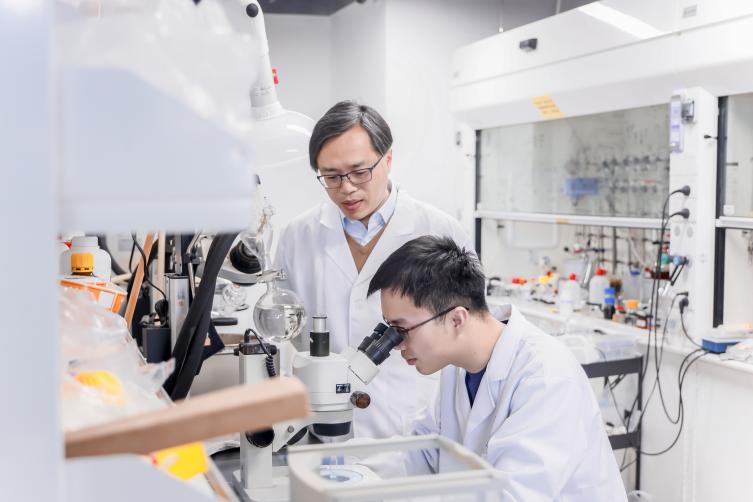
Back in 2010, HUANG Feihe’s team discovered this magnetic-like attraction between pillar[5]arenes and alkyl chains. They embedded a pillar[5]arene into a MOF to create a kind of “molecular catcher”: a highly specific, structured trap for long-chain compounds.
When a long-chain molecule enters the MOF, the pillar[5]arene unit grab onto it and help align it neatly inside the crystal lattice. It’s like catching a wriggling snake and holding it still so we can take a clear picture.
This neat alignment makes all the difference. Once captured in this orderly manner, even notoriously difficult molecules can be analyzed using standard crystallographic software, often with minimal human input.
“The preparation process takes less than ten minutes,” WU Yitao notes. “It works in different solvents and doesn’t require tedious procedures like solvent exchange or slow absorption.”
In their study, the team used this technique to determine the structures of 63 compounds, including 48 with alkyl chains, using a combination of single-crystal X-ray diffraction, NMR, and mass spectrometry. Impressively, many of the structures were resolved automatically using SHELXT, a crystallographic software tool.
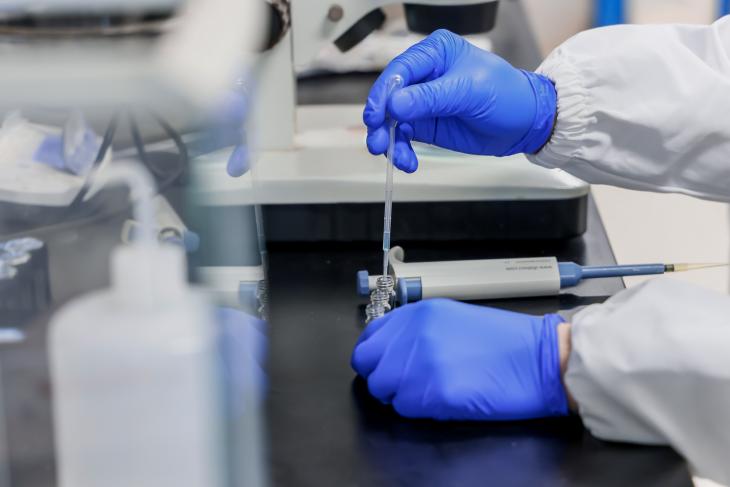
Among the compounds analyzed was Dojolvi, an FDA-approved drug used to treat long-chain fatty acid oxidation disorders. Despite its regulatory approval nearly five years ago, its full single-crystal structure had never been resolved until now.
“The fact that we could finally ‘see’ the structure of Dojolvi speaks to the power of this approach,” says WU Yitao.
The road to publication wasn’t without its bumps. When the team first submitted their findings to Nature, reviewers praised the innovation but urged the authors to demonstrate broader applicability. In response, HUANG Feihe sent out an open call to researchers across China, offering to analyze their alkyl-containing samples for free.
Sixteen research groups responded, providing a wide variety of challenging compounds. With this expanded dataset, the team was able to prove that their method wasn’t just a one-off. It could be applied broadly, reliably, and efficiently across numerous substrates.
“This is not just an academic exercise,” says HUANG Feihe. “We’ve developed a tool that could reshape how we determine molecular structures in natural products, pharmaceuticals, and synthetic chemistry.”
More information: The co-first authors of the paper are Dr. WU Yitao, a postdoctoral researcher at the Department of Chemistry, Zhejiang University, Professor SHI Le, a distinguished professor at Zhejiang Normal University, and Dr. XU Lei, a PhD graduate from Nanjing University. The corresponding authors are Professor HUANG Feihe, Professor HUA Bin, and Professor CHEN Zhijie from the Department of Chemistry at Zhejiang University, and Professor Jonathan L. Sessler from The University of Texas at Austin.
Adapted and translated from the article by ZHA Meng
Translator: FANG Fumin
Photo: ZHE Ying, and the research team
Editor: TIAN Minjie