ZJU unveils the world’s first AI-powered crop breeding platform


Zhejiang University has launched what is believed to be the world’s first artificial intelligence platform designed to accelerate crop breeding, marking a major step forward for the integration of AI and agriculture.
The platform, known as AI Breeder for Crops (ABC), was officially announced at the West Lake Forum on “AI + Biological Breeding” on September 26. It combines large-scale genome databases with AI-driven acceleration algorithms to predict, screen and design optimal crop varieties. According to the researchers, the technology can shorten the breeding cycle of cotton from six to eight years to just three to four, while improving hybrid combination efficiency by a factor of twenty.

Developed by Professor ZHANG Tianzhen’s team at ZJU in collaboration with Huawei and Beijing Daqiuyin Digital Technology, the system builds on more than two decades of research into cotton genetics.
The team previously analyzed over 5,000 global cotton varieties, identifying more than 1,000 key gene loci related to yield and fiber quality. Their COTTONOMICS database has since become a widely used reference platform for cotton researchers worldwide.
Now, with the rollout of ABC, breeders no longer need to manually interpret genomic reports. Instead, they can simply type natural language queries, such as “Which varieties carry drought-resistant genes?”, and receive instant results. The platform can also automatically generate hybrid breeding strategies based on desired traits.
The platform was designed with multi-crop compatibility, and is already being adapted for rice, soybean, rapeseed, watermelon, and broccoli, potentially expanding its impact far beyond cotton.
To support large-scale precision screening, another ZJU team led by Professor YING Yibin has developed a full suite of automated seed-sampling and sequencing robots. The system uses robotic arms and machine vision to slice microscopic samples from individual seeds, similar to performing a PCR test without affecting seed viability. This boosts screening throughput from 800 to over 8,000 seeds per day, reducing labor while improving accuracy.
If a seed carries the desired gene profile, it is automatically preserved for further propagation; if not, it is discarded. This allows breeders to identify “elite seeds” before they ever reach the ground.
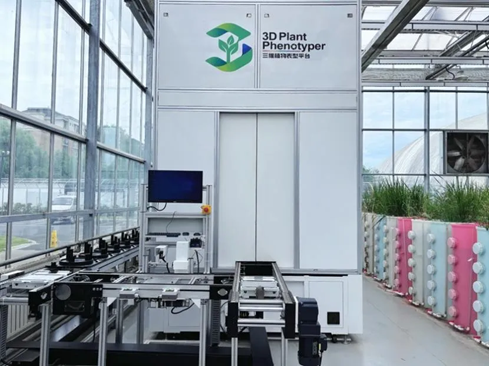
Meanwhile, another team led by Professor HE Yong and Prof. CEN Haiyan has developed a high-throughput 3D phenotyping system for real-time crop monitoring. Seedlings are scanned using visible-light, depth and multispectral cameras, after which AI reconstructs a full 3D model and quantifies key health indicators such as chlorophyll, moisture and nitrogen content.
Each plant is assigned a QR code that continuously logs growth and irrigation data, enabling large-scale tracking throughout development.
By digitizing the entire breeding pipeline, from gene discovery to seed selection to field monitoring, the researchers say that future crops could be designed rather than discovered. The ABC platform provides one of the clearest real-world examples to date of how machine intelligence may reshape food production.
When AI meets life science, breeding is no longer a waiting game, seed selection is no longer guesswork, and plant growth is no longer a mystery.
Translator: FANG Fumin
Editor: HAN Xiao