Chasing the sun, powering the night


An engineer’s 16-year pursuit of solar thermal power offers one answer to a growing challenge: making renewable electricity available when it is needed.
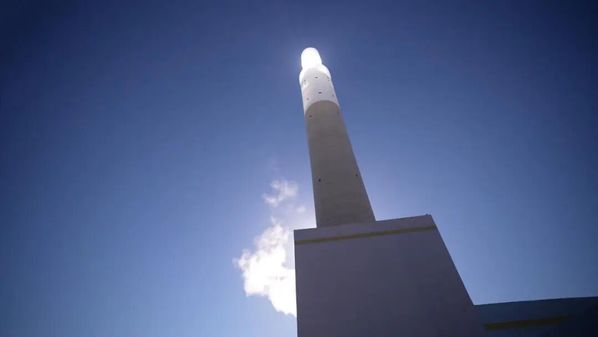
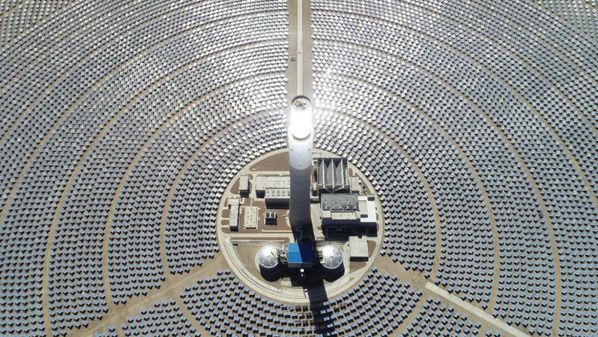
At the northeastern edge of China’s Qaidam Basin, 27,135 mirrors fan out around a 200-meter tower. As the sun crosses the sky, they turn slowly, directing its rays toward a receiver at the top.
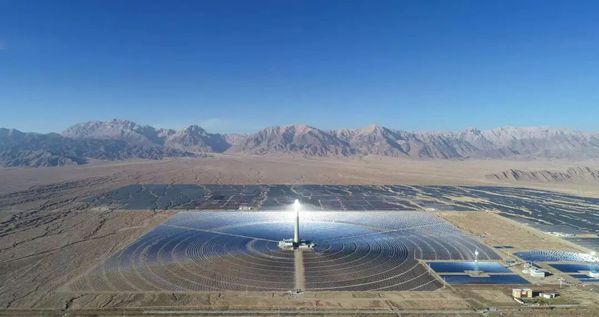
The Qilian Mountains rise to the north. The Kunlun Mountains stretch across the southern horizon. Between them, on an expanse of stony desert, the Delingha solar thermal power station harnesses sunlight to do something ordinary solar panels cannot do on their own: generate electricity after dark.
Delingha means “golden world” in Mongolian. With more than 3,200 hours of sunshine a year, this small city in Qinghai Province lives up to its name.For Jin Jianxiang, a professor at Zhejiang University’s College of Control Science and Engineering and the founder of Cosin Solar, the challenge has been turning that abundance into dependable power. Over 16 years, he and his team have worked their way from a small experimental installation in Hangzhou to commercial plants in China’s desert interior.
Their 50-megawatt station in Delingha has now met its annual generation target for four consecutive years. Its progress points to a question increasingly central to China’s energy transition: How can a country expanding its renewable energy capacity so rapidly make better use of the electricity it produces?
China’s wind and photovoltaic solar capacity reached 1.84 billion kilowatts by the end of 2025, accounting for roughly 47 percent of its total generating capacity and surpassing fossil fuel-fired capacity for the first time. Yet wind and solar supplied electricity equivalent to about 22 percent of national consumption that year, according to China’s National Energy Administration.
Installed capacity, however, is not the same as actual generation: wind and solar output depend on the weather and daylight. A separate challenge is curtailment — reducing potential output when the grid cannot accommodate it.
In Qinghai, 16.6 percent of potential photovoltaic generation was curtailed in 2025, according to figures from China’s National Renewable Energy Monitoring Center. Solar output can overwhelm demand around midday, then disappear as evening demand rises.
Solar thermal power offers one way to bridge that gap.Photovoltaic panels convert sunlight directly into electricity. A solar thermal plant first converts it into heat — creating an opportunity to store energy before producing power.

In Delingha, the mirrors, known as heliostats, concentrate sunlight on the tower’s receiver, heating molten salt to 565degrees Celsius, or about 1,050degrees Fahrenheit. The hot salt is stored in a tank and later used to produce steam, which drives a turbine.The process integrates four systems: solar concentration, heat absorption, heat storage and transfer, and electricity generation.
Salt can be reused repeatedly, with little loss over the plant’s operating life. Qinghai’s extensive salt-lake resources also offer a potential local advantage.
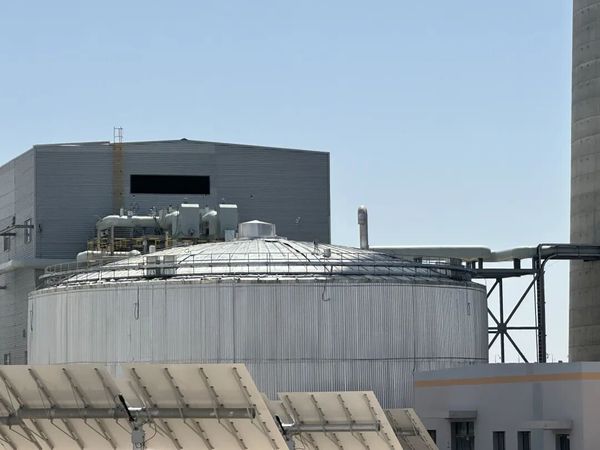
During a visit by a Zhejiang University summer field-study group, Cao Dehong, the plant’s administrative director, pointed to a control-room screen as he explained how the system works. The station has seven hours of thermal storage. During the day, it generates electricity while storing heat for later use. After sunset, that stored heat allows it to keep operating.
With sufficient sunlight and careful management of its reserves, the plant can sustain generation through the day and night.It can also help stabilize a grid increasingly supplied by wind and solar power.
Like a conventional coal plant, the station uses a synchronous generator. Its rotating machinery provides inertia, helping resist sudden changes in grid frequency, while the generating system also supports voltage control.
The plant can adjust its output to changing demand, reducing generation when wind and photovoltaic power are plentiful and increasing it during peak hours. That flexibility makes stored solar heat valuable beyond the electricity it produces.Making the technology work, however, required solving a formidable control problem.
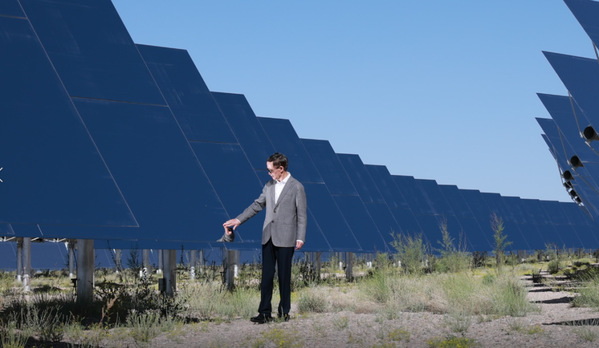
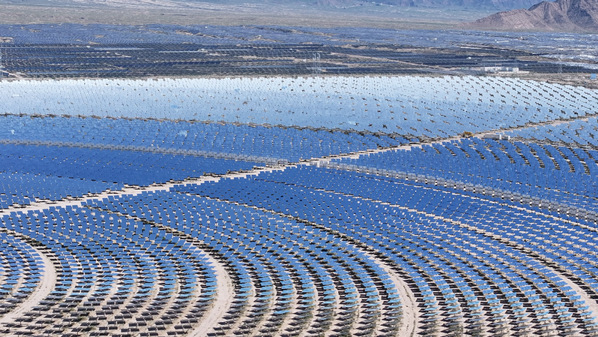
Concentrated solar power has four main configurations: parabolic troughs, central towers, linear Fresnel reflectors and dishes. Tower systems offer the prospect of high efficiency and lower costs as projects grow larger. They also demand exceptional precision.Each heliostat must move along two axes, continually adjusting its angle as the sun changes position. Tens of thousands of mirrors must work together to direct sunlight onto the receiver.
For Prof. Jin Jianxiang, who entered Zhejiang University in 1980 and built his career in industrial control, the technology was new, but the underlying challenge was familiar.When he turned to solar thermal power in 2010, tower technology was only beginning to find commercial applications overseas. A handful of European and American companies dominated key equipment and materials. China lacked mature domestic technology, a complete supply chain and a proven commercial model.
Prof. Jin Jianxiang saw an opening.
“The next generation of solar thermal technology wasn’t mature overseas either,” he said. “They were only two or three years ahead of us. Chinese engineers should have more confidence. With a technology that is still developing, we should be able to bring it to maturity faster.”
At its heart, he believed, solar thermal generation was a control problem on a much larger scale.
Starting with the underlying algorithms, his team spent a year developing the controls needed to coordinate the mirrors and concentrate sunlight on the receiver.That was a difficulty they had anticipated. Another came from an unlikely source.
After the 50-megawatt plant began operating, its steam turbine repeatedly broke down. A technology used in conventional power stations for more than a century proved troublesome in its new setting. In 2020 and 2021, the turbine was sent back to the manufacturer repeatedly for repairs that took months at a time.
Prof. JIN Jianxiang and his colleagues examined the plant system by system, from its controls to its thermal equipment. In August 2021, they completed the final modifications to the turbine and piping.
Performance began to improve. The generating unit ran more reliably, and electricity output climbed.
As the operating data accumulated, Prof. Jin Jianxiang took his case to government officials, arguing that solar thermal power deserved a place in China’s changing electricity system. To him, the stakes extended beyond the fortunes of a single plant. A grid increasingly dependent on variable renewable energy would need sources of power that could be stored and delivered reliably.
The breakthrough followed more than a decade of incremental progress. The team had started in 2010 with a modest test facility in Hangzhou: just over 200 heliostats and a small receiver.
On July 5, 2013, its 10-megawatt Delingha tower plant connected to the grid, becoming China’s first commercially operated concentrated solar power station. Its mirror field contained 21,500 heliostats serving two towers, each with a generating capacity of five megawatts.
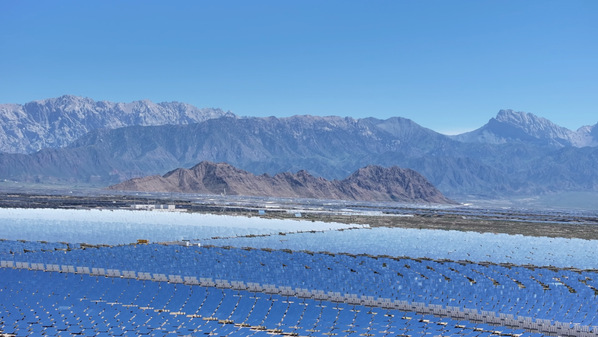
The larger, 50-megawatt molten-salt plant connected to the grid on December 30, 2018. More than 95 percent of its equipment was domestically produced. In 2022, its annual electricity generation exceeded its design target, beginning a four-year run of meeting annual goals.
The next step is larger still.
Construction began in October 2025 on a 350-megawatt project in Golmud, also in Qinghai. Designed around three towers supplying a single turbine-generator unit, it is scheduled to connect to the grid in 2027.
As the projects have grown, the team’s reported generating costs have fallen: from 1.20 yuan per kilowatt-hour to 0.55 yuan, with a target of 0.38 yuan for the new project. Reaching that target would strengthen the technology’s prospects for wider use.
The team has also moved into international standard-setting.
In January 2026, the International Electrotechnical Commission published IEC 62862-4-2, a standard covering heliostat-field control systems for solar tower plants. Prof. Jin Jianxiang led its development. The work marked a shift for a team that had begun by trying to catch up with overseas technology and was now helping set international standards for its use.
Chinese mythology tells of Kuafu, a giant who chased the sun and died of thirst before reaching it. His discarded walking stick became a grove of trees.
Sixteen years into his own pursuit, Prof. Jin Jianxiang has helped build something that endures beyond daylight: power stations that keep the sun’s energy working after dark.
Adapted and translated from the article written by Xu Ziyang
Translator: Fang Fumin
Editor: Ding Chenwei