Information Design for Social Learning on a Recommendation Platform


Time: 15:00-16:30
Venue: Room 718, School of Economics Zhejiang University, Zijingang Campus
Speaker:
Category: Talk & Lecture
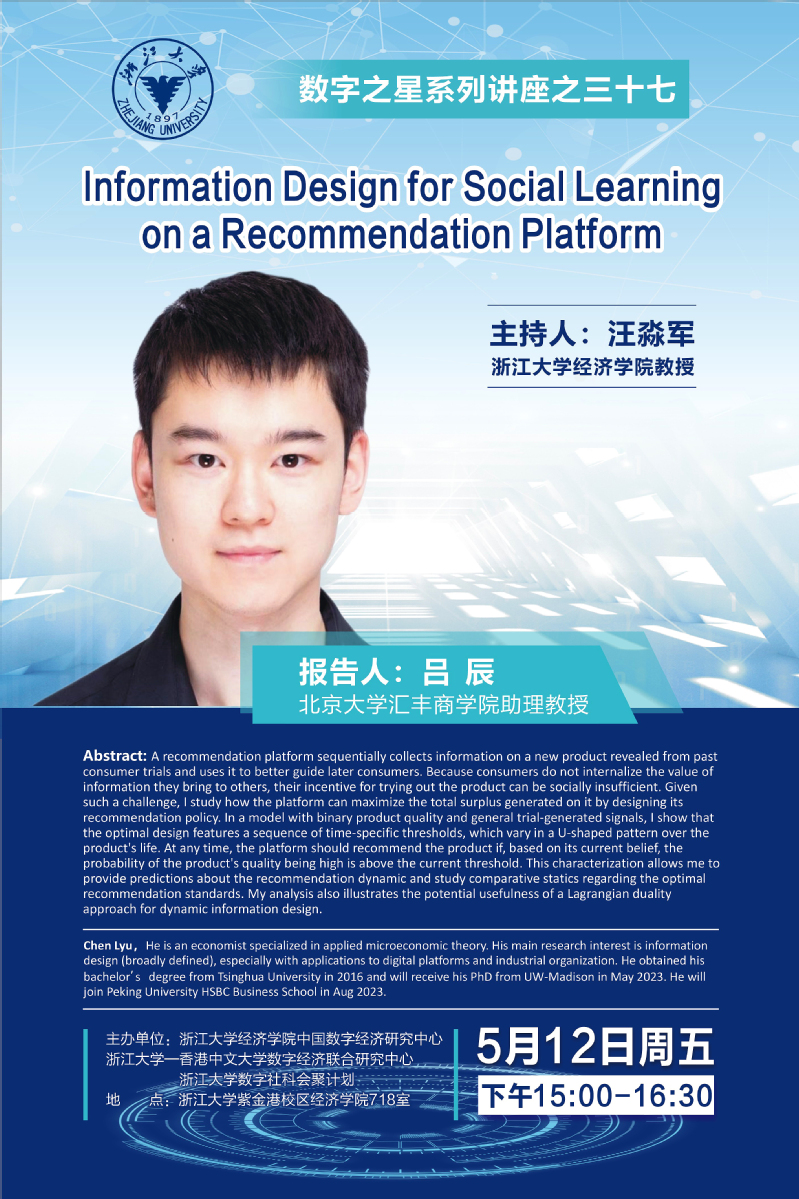
Speaker: Lyu Chen (Peking University HSBC Business School)
Venue: Room 718, School of Economics Zhejiang University, Zijingang Campus
Abstract: A recommendation platform sequentially collects information on a new product revealed from past consumer trials and uses it to better guide later consumers. Because consumers do not internalize the value of information they bring to others, their incentive for trying out the product can be socially insufficient. Given such a challenge, study howthe platform can maximize the total surplus generated on it by designing its recommendation policy. In a model with binary product quality and general trial-generated signals. I show that the optimal design features a sequence of time-specific thresholds, which vary in a U-shaped pattern over the product's life. At any time, the platform should recommend the product if based on its current belief the probability of the product's quality being high is above the current threshold. This characterization allows me to provide predictions about the recommendation dynamic and study comparative statics regarding the optima recommendation standards. My analysis also illustrates the potential usefulness of a Lagrangian duality approach for dynamic information design.