ZJU researchers unveil new mechanism regulating lipid metabolism in butterfly and moth wings


The metamorphosis of a humble caterpillar into a vibrant butterfly is a marvel of nature. The development of insect wings plays a key role in their evolution. Yet, due to the diversity in wing morphology and dynamic energy demands, the molecular mechanisms behind metabolic adaptations during wing evolution in insects remain largely obscure.
Now, a groundbreaking study by Professor WANG Huabing’s research group at the College of Animal Sciences has shed new light on this process. Published in Molecular Biology and Evolution, the paper titled “Evolutionary novelty of Apolipoprotein D facilitates metabolic plasticity in lepidopteran wings” reveals a novel mechanism at the heart of lipid metabolism in Lepidoptera—the insect order that includes butterflies and moths.
Lipid metabolism is essential for the development of organs and serves as a crucial source of energy in insects. Building on genomic research from 10 insect orders and over 100 species, the team discovered that duplication events of ApoD genes were observed in several insects and extensively conserved in Lepidoptera. These lepidopteran insects include butterflies and moths, rely on their wings not only for flight but also for essential functions such as mating, protection, and thermoregulation.
Through a combination of comparative genomics and transcriptomic analysis, the researchers found that a newly duplicated gene, ApoD2, is highly expressed in Lepidopteran wings. This gene encodes a unique C-terminal tail that distinguishes it from other forms of ApoD. The study’s in vitro experiments confirmed that this distinct tail structure endows ApoD2 with new ligand-binding properties, facilitating its role in the complex regulation of lipid metabolism.
Using the silkworm, an ideal model organism for Lepidoptera, the team applied cutting-edge techniques, including transcriptomics, metabolomics, lipidomics, proteomics, and functional assays, to reveal the role of ApoD2 in lipid metabolism and energy homeostasis. Their findings not only deepen our understanding of the molecular mechanisms regulating lipid metabolism in insects but also provide valuable insights into the broader processes of adaptive evolution in the insect world.
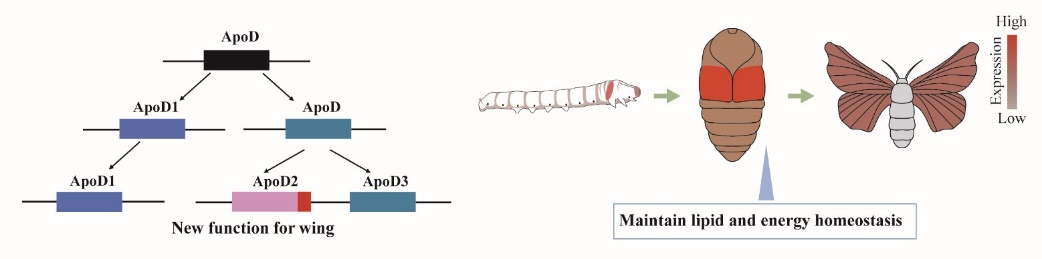
Summary of the evolutionary novelty and history of Apolipoprotein D in Lepidoptera
This research opens new avenues for exploring how genetic innovation, such as gene duplication, can drive metabolic flexibility and support the evolution of complex traits like wings in Lepidoptera. As we uncover more about these intricate biological systems, we gain a clearer picture of how insects have adapted to their environments over millions of years.
Adapted and translated from the article by the research team
Translator: FANG Fumin
Editor: TIAN Minjie