Experts from 30+ countries and regions convene at ZJU for APMEC 2026


“China’s medicine has moved from being a follower to becoming a leader.”
“We hope more people around the world will see, use, and benefit from Chinese standards and Chinese technology.”
“Exchanging ideas with our Chinese counterparts has been truly delightful.”
Hosted in the Chinese mainland for the first time, the Asia Pacific Medical Education Conference 2026 (APMEC 2026), jointly organized by the Yong Loo Lin School of Medicine at the National University of Singapore and the International School of Medicine at Zhejiang University, arrived in Hangzhou and Yiwu with a clear message: medical education is being reshaped by technology, and cross-border collaboration is accelerating that change. Nearly 800 experts and scholars from more than 30 countries and regions, including those from the Asia-Pacific region as well as the United Kingdom, Germany, the Netherlands, and South Africa, gathered for workshops, roundtable forums, site visits, and field research, exchanging ideas on the frontiers of medical education and mapping out new opportunities for global partnership.A full-scale 1:1 digital reconstruction of the human vascular system, capturing both structure and function, allows doctors to examine minute vascular changes from any angle, at any level of detail, through a “whole-vascular digital human.” With AI-assisted analysis, doctors can tailor diagnostic and treatment pathways to each patient, while forecasting likely outcomes and potential risks.
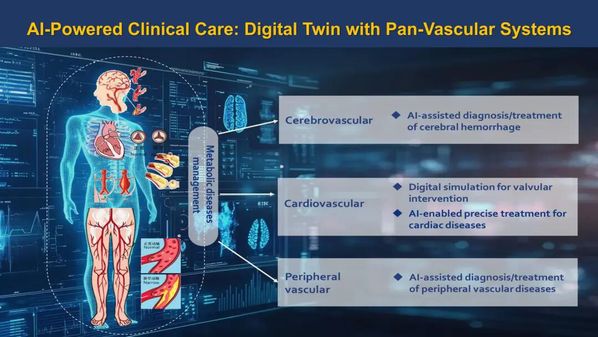
This cutting-edge technology was presented at the conference by WANG Jian’an, Fellow of the Chinese Academy of Sciences and President of the Second Affiliated Hospital of Zhejiang University School of Medicine. What drew audible amazement from the audience was its promise to overcome long-standing limitations of conventional imaging: by detecting disease features that can elude the human eye, the digital-twin approach may help clinicians recognize warning signs at the very earliest stage of illness.
“Twenty years ago, it was mostly Chinese students who went abroad to study medicine,” said HUANG Hefeng, Fellow of the Chinese Academy of Sciences and Director of the Faculty of Medicine and Pharmaceutical Sciences. “Today, thousands of international students come to China to study medicine every year, yet many people still haven’t seen the scale of this shift. By convening a high-level international conference, we hope to expand high-standard opening-up in medicine so that more people worldwide can see, use, and benefit from Chinese standards and Chinese technology.”

“In developing and applying new technologies, Chinese doctors are already at the forefront globally,” remarked Emma Keeling, Associate Dean of the Faculty of Medicine at Imperial College London.
In addition to keynote speeches, the conference also featured nearly a hundred sessions in formats such as seminars, workshops, and roundtable discussions. Participants focused on major topics including AI + medical education, integrating clinical practice with scientific research, and faculty development.
Wong Mun Loke, a professor at the National University of Singapore, both the promise and responsibility of the moment: “Artificial intelligence has broad prospects in education. As medical educators, we must embrace the technology first, so that we can teach students to use AI responsibly, boosting efficiency while also stimulating their initiative and creativity.”
“I was the first American medical student to come to the Chinese mainland on an exchange program after the establishment of diplomatic relations between China and the United States.” recalled David Eisenberg, a professor at Harvard University. “I believe the East can learn from the West, and the West can also learn from the East.” Deeply influenced by traditional Chinese medical theories, Eisenberg said he has woven Eastern life philosophy, especially its emphasis on holism and prevention, into modern Western medical training, and has developed an innovative health intervention model that combines nutrition, preventive medicine, and behavioral science.
For Zhejiang University, the conference was also a platform to expand pragmatic cooperation across the region. “Using this conference as a bridge, we look forward to further deepening cooperation among Asia-Pacific countries and institutions, promoting the sharing of medical education resources, advancing mutual learning among civilizations through inclusiveness, and jointly building a closer Asia-Pacific community for medical education,” said LI Xiaoming, Vice President of Zhejiang University. “In doing so, we hope to contribute wisdom and strength to safeguarding the health and well-being of people in the Asia-Pacific region and around the world.”

One showcase drew particular attention: Zhejiang University’s “growth-oriented competency evaluation system” for undergraduate medical training. The university’s independently developed Qizhen Smart Medicine AI platform offers intelligent, high-precision assessment of student learning. Using “sandwich-style backward design” to deliver personalized skills training as one example, data presented at the conference indicated significant gains in students’ performance across multiple competencies, alongside marked increases in self-confidence. Encouragingly, an international English version of the platform—AISMED—built upon the Chinese-language system, is expected to open soon, supporting deeper interconnection in global medical education.
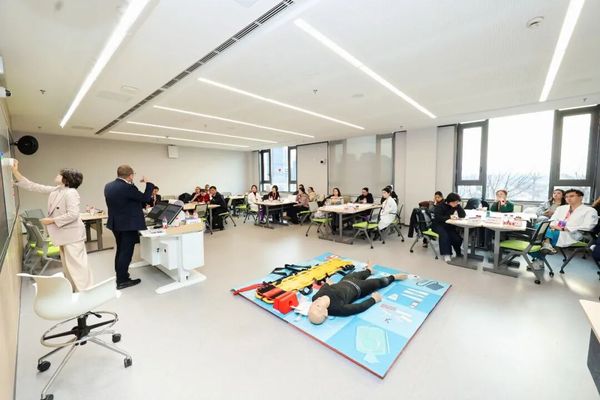
Innovation was also on display in skills training. A team from the First Affiliated Hospital of Zhejiang University School of Medicine demonstrated augmented reality (AR) in teaching the safe transfer of patients with spinal injuries, a procedure known for its high risk and complexity. In conventional instruction, the workflow can be difficult to visualize and costly to master. With AR, the process becomes a three-dimensional, interactive experience, enabling immersive learning and clearer understanding of critical steps.
“At this conference, Chinese colleagues showcased a wealth of new technologies and achievements that inspired me greatly,” said Peter de Jong, President of the International Association of Medical Science Educators. “We have very promising prospects for cooperation. This hands-on experience is more direct and effective than reading papers or communicating online.”
“China is an emerging force in medical education,” said Dr. Dujeepa, Senior Director of the Center for Medical Education at the NUS Yong Loo Lin School of Medicine. “Through APMEC 2026, we hope to deepen exchanges and expand cooperation with our Chinese counterparts.”
Source: International School of Medicine
Translator: FANG Fumin
Editor: HAN Xiao