ZJUers clinch gold medals at iGEM


The iGEM Giant Jamboree 2025 was recently held in Paris, where three teams from Zhejiang University achieved remarkable success with their outstanding research capabilities and exceptional on-site performance, creating a proud and memorable moment for the ZJU community.
iGEM, a leading global academic competition in synthetic biology and the world’s largest event of its kind, attracted more than 400 teams from around the world this year. Zhejiang University’s IZJU-China team won 3rd place globally in the iGEM Competition for Collegiate Teams, earning a gold medal, along with the Best Diagnostics Project Award, the Best Composite Part Award, and a nomination for the Best Model, demonstrating strong overall competitiveness. The HiZJU-China team also secured a gold medal and received a nomination for the Safety and Security Award for their cutting-edge research in living therapeutic design. The ZJU-China team delivered an excellent performance as well, winning a silver medal.
From precision medicine to environmental protection, ZJUers are responding to global challenges with interdisciplinary innovation, offering “ZJU Solutions” at the forefront of global science and technology.
What innovative designs led to such achievements in Paris? Let us take a closer look at the three teams and see how they leveraged cross-disciplinary creativity to address issues of our time and how they wrote an impressive chapter for ZJU on the international stage.
IZJU-China: A “targeted killer” for antimicrobial resistance
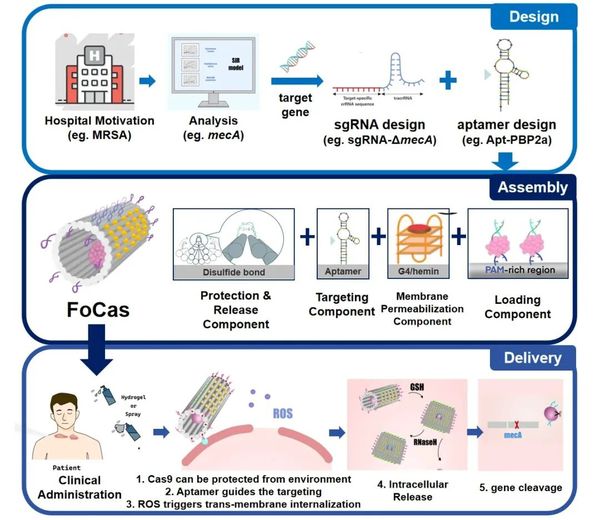
The IZJU-China team confronted the global public health threat of antimicrobial resistance head-on. By integrating gene-editing technology with DNA origami, they developed an innovative platform named “FoCas.”
This system combines the CRISPR-Cas9 genome-editing mechanism with programmable DNA-origami nanostructures. CRISPR-Cas9 enables precise cutting of antibiotic-resistant genes, while the DNA-origami structures serve as targeted delivery vehicles that selectively bind pathogens and release the editing components inside the cells, thus achieving efficient knockout of resistance genes. This system holds promise as a new antibacterial strategy against superbug infections.
The team brings together students from the ZJU-UoE Institute (ZJE), the ZJU-UIUC Institute (ZJUI), the School of Pharmacy, and other schools, forming a diverse, cross-campus, interdisciplinary group. Members contributed expertise in wet lab experiments, modeling, programming, public engagement, and business planning, enabling seamless collaboration from technology development to outreach.
The advisor group, also highly interdisciplinary and international, includes faculty from ZJE, ZJUI, and the College of Life Sciences, providing comprehensive support from scientific design to global communication.
IZJU-China’s achievements are deeply rooted in the unique educational ecosystem of the International Campus, Zhejiang University. Here, “100% undergraduate participation in laboratory-based research” is more than a slogan; it is a reality. From their freshman year, students may join faculty labs and engage in real research.
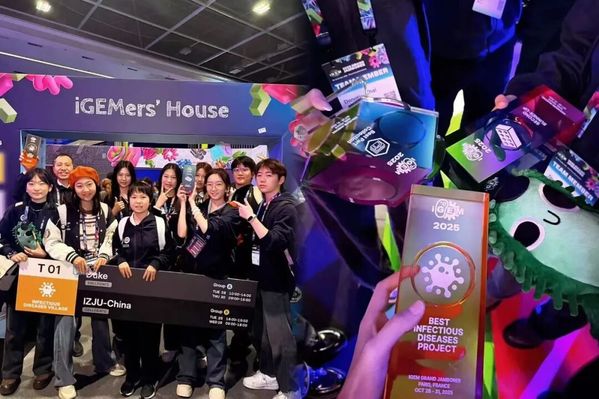
During the competition, the ZJE Biomed-X Laboratory the served as the team’s main base. This integrated innovation hub offers advanced experimental facilities as well as spaces for lectures, communication, and project incubation. From project design and experimentation to social survey and public engagement, the iGEM journey is a fitting testament to the International Campus’s multi-tiered training model of “interactive teaching – knowledge application – innovation training – research practice.”
HiZJU-China: Turning gut probiotics into an “intelligent drug factory”
Obesity and associated metabolic diseases such as diabetes have become pressing global health issues. Traditional surgical and drug therapies often come with significant side effects, short therapeutic windows, and easy relapse.
In response, the HiZJU-China team turned their attention to a probiotic naturally found in the human gut—Escherichia coli Nissle 1917—and used synthetic biology to reprogram it to respond to green tea metabolites and achieve precise, controllable drug production.
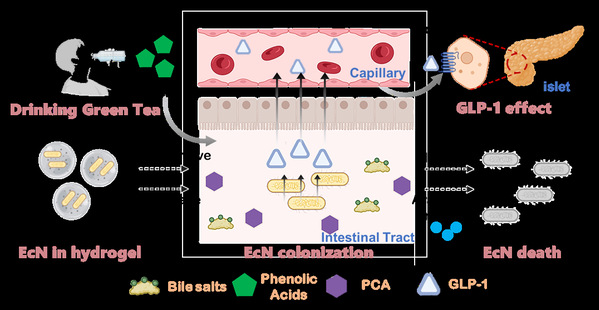
Their project, “GlucoXpert,” integrates four modules, including sensing circuits, protein engineering, biosafety circuits, and a drug delivery & characterization platform, to achieve long-term, stable control of body weight and blood glucose.
“When we drink green tea, the GlucoXpert system receives a ‘start work’ signal and begins efficiently producing modified GLP-1 peptide drugs in the gut,” explained team leader ZHENG Shanyi.
To ensure biosafety, they designed a dual safety mechanism based on arabinose administration and low-temperature sensing, ensuring engineered bacteria can be cleared when necessary. This innovative concept opens up new avenues for developing smarter, safer, and more convenient oral weight-loss therapies.
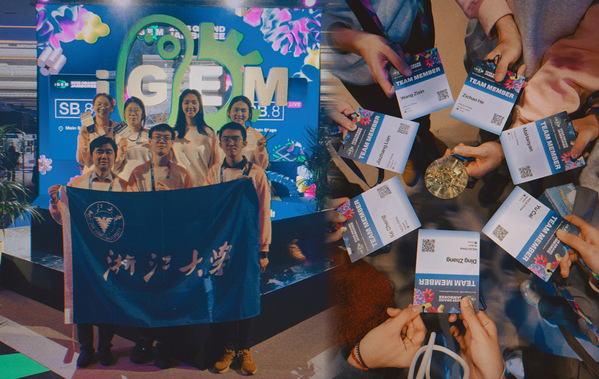
The team’s impressive results were made possible by interdisciplinary collaboration and university support. Members came from bioengineering, agronomy, biological sciences, robotics engineering, pharmacy, and other fields, integrating diverse perspectives over the year-long project. “We encourage students to explore cutting-edge intersections and cultivate a global vision,” said team primary PI LIAN Jiachang. “This is not just a competition; it is indeed a miniature laboratory-to-industry practice.”
ZJU-China: Building an underwater “intelligent sensing lifeform”
Against the backdrop of severe global aquatic environmental challenges, the ZJU-China team developed LumaManta, a system that pioneers a new paradigm for underwater environmental monitoring and remediation.
This integrated solution, which combines synthetic biology, artificial intelligence, and ecological science, functions like an intelligent organism operating underwater, capable of holistic sensing and adaptive response to aquatic environments.
LumaManta’s core lies in its four synergistic modules. The detection module uses immobilized DNA templates and allosteric transcription factors to detect pollutants and amplify signals, generating fluorescence correlated with pollutant concentration. The light-control production module employs a light-controlled biological logic circuit to sustain protein supply for the detection system. The treatment module builds a catalytic platform using self-assembling protein scaffolds to capture and degrade pollutants efficiently. The symbiosis module creates a sustainable energy-producing ecosystem using engineered cyanobacteria and E. coli, enabling long-term stable operation.
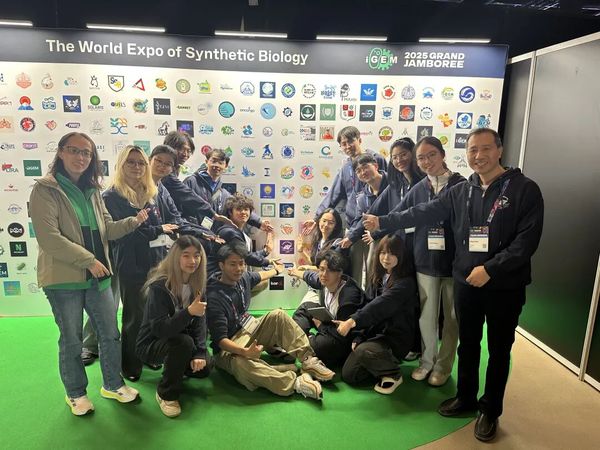
“We wanted to create not just a detection device, but a system that can understand, respond to, and even ‘communicate’ with its environment,” explained team leader ZHAO Yiyang.
The 14-member team came from the College of Life Sciences, the Chu Kochen Honors College, the School of Medicine, the School of Pharmacy, the College of Computer Science and Technology, the Department of Chemistry, the College of Biosystems Engineering and Food Science, and the College of Control Science and Engineering. They capitalized on interdisciplinary synergy to complete the project from conceptualization to experimental validation.
“This team spans multiple disciplines and age groups; iGEM is what brings us together,” reflected co-leader HU Xiangjun. “Since the establishment of our team in February, we’ve grown from hesitant brainstorms to intense, inspiration-filled design sessions. The late nights we spent working together will stay with me forever.”
Translator: FANG Fumin
Editor: HAN Xiao