Walking the Silk Roads with students: Professor FENG Peihong makes history come alive


Have you ever met a history professor like this?
He walks into the classroom wearing a hat shaped like a fish.
His office is packed with books from floor to ceiling.
He goes on late-night bike rides around West Lake with his students.
And in his spare time, he volunteers as a museum guide.
This is Professor FENG Peihong from the School of History at Zhejiang University. Through “a fish,” he solves historical mysteries, and helps students discover history for themselves.

History can be fun
At the start of his course The Silk Roads and Cultural Exchange, students watched in surprise as Professor Feng entered the classroom with what looked like a fish on his head. It was a reconstruction of a traditional fish-head crown, once worn in the ancient “Fish Kingdom” along the Silk Roads.
The class soon became a lively discussion on the cultural meanings behind headwear. Students brought self-made crowns—lion hats, mouse crowns, tiger-head caps—and in groups presented cultures of different Western Regions based on their assigned readings.
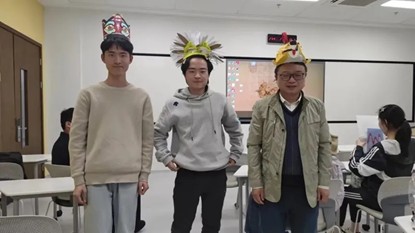
“Knowledge doesn’t come only from books,” Professor FENG explains. “You have to experience it, make things with your hands, and use your mind to give knowledge a visible form.”
In this course, students grow in multiple ways. They learn to read historical texts with focus and patience, while developing interdisciplinary skills through hands-on practice and group collaboration.
Offered for eight years, the class is full of memorable moments—playing the huqin, performing the Sogdian Whirl dance, debating cultural contributions along the Silk Roads. History here is not confined to pages; it becomes tangible, vivid, and human.
Learning history, slowly and deeply
Beyond undergraduate teaching, Professor FENG runs graduate reading seminars. Through close reading, careful thinking, and open discussion, he guides students to explore historical puzzles and discover the appeal of academic research.
The seminar meets weekly for informal conversation, and every two weeks for intensive source readings or research presentations. Rather than encouraging students to race through large quantities of material, Professor FENG emphasizes slow reading—teaching students to question sources, trace evidence, and engage deeply with texts.
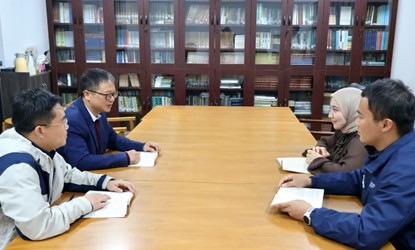
Professor FENG firmly believes that history is not an isolated field. He encourages students to step outside textbooks and search for historical clues in archaeology, artifacts, and daily life.
To offer firsthand cultural experience, he invites students to volunteer as museum guides—leading by example as a docent at the university art museum.
A community of history “puzzle-solvers”
Outside the classroom, Professor FENG is deeply committed to research. In 1999, a joint tomb of YU Hong and his wife was discovered in Taiyuan,containing an epitaph that mentioned a mysterious “Fish Kingdom”—launching a long-standing historical puzzle.
Captivated, Professor FENG led decades of research, examining texts, visiting Yu clan villages, and collaborating with scholars across China and abroad. Gradually, the mystery of the “Fish Kingdom” was solved.
What was once a distant name in ancient records became a living thread, linking regions on both sides of the Pamirs and connecting Central Asia with the Yellow River basin.
Behind every solved historical mystery is a group of people who truly love history. “I hope to cultivate warm-hearted people,” Professor FENG says.
He values daily connection with his students—listening, learning alongside them, and walking with them through both academic and personal journeys. That warmth has become a form of legacy. Many of his former students have gone on to careers in historical research and teaching.
A PhD graduate YIN Panpan, recalls: “Even years after graduating, every Spring Festival I remember Professor FENG biking around West Lake with me on New Year’s Eve—talking about research, life, and the future. Now in academia myself, I learned from him not only how to be a historian, but how to be a history teacher.”
From solving the mystery of the “Fish Kingdom” to nurturing a community of curious minds, Professor FENG Peihong uses engaging teaching and genuine care to raise a new generation of history “puzzle-solvers”—keeping the flame of scholarship alive.
Adapted and translated from the article written by Zhejiang University
Translator: MING XuenAmelia(’26, Journalism)
Editor: HAN Xiao